You can now try Windows 11’s new File Explorer in preview builds
Nhận đường liên kết
Facebook
X
Pinterest
Email
Ứng dụng khác
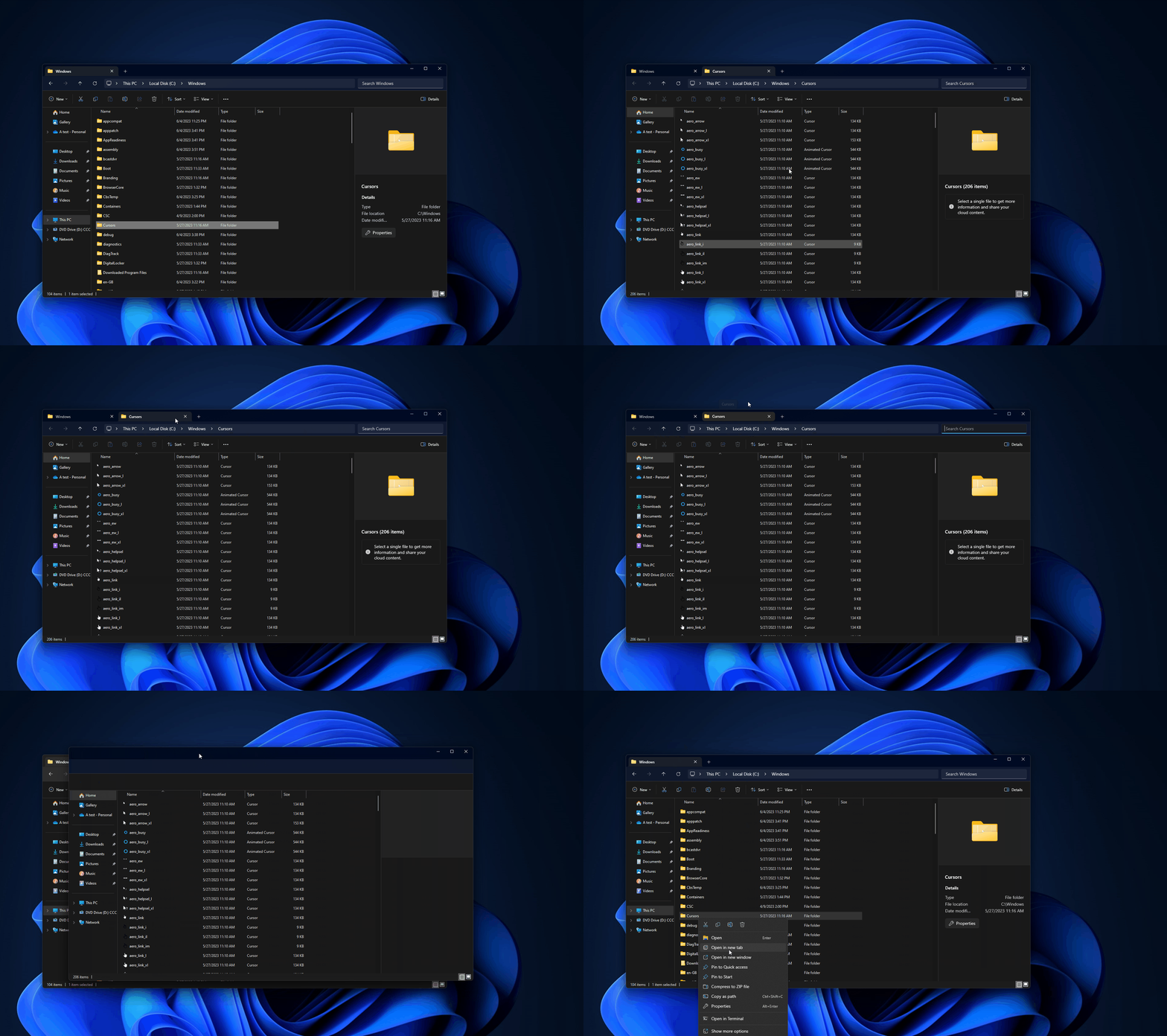
Those who have signed up for Windows Insider and selected the Dev Channel in Windows Insider Settings will be able to try out the updated File Explorer immediately. The updated version is meant to make using the software easier and more natural.
The updated File Explorer has a new "Home" that uses the Fluent Design System for a unified, user-friendly, and engaging interface. In Windows 11, if you sign in using an Azure Active Directory (AAD) account, you'll see a carousel of suggested documents.
Cloud-based files that the user either owns or has access to through collaboration are used as recommendations. Quick Access folders, Favorites, and Recent in File Explorer are updated with the help of WinUI, a native user experience framework for Windows applications.
A new address bar and improved search functionality have also been added to File Explorer as part of the update. The new address bar is capable of intelligently differentiating between local and cloud folders, and for OneDrive users, it even highlights the sync status and quota flyout.
TheWindowsFan.com Provided the Image.
Members of the Dev Channel are among the first to receive this update. Microsoft will collect user feedback and analyze their reactions before releasing the product.
Along with the revamp of File Explorer, With Dynamic Lighting, Microsoft is also introducing, allowing for in-built management of light sources via the public HID LampArray standard. The goal is to make it easier for users to switch between different RGB devices and software by increasing compatibility.
Users can now adjust the brightness of their screens thanks to the addition of the Dynamic Lighting settings page. Multiple keyboards and mice from Acer, ASUS, HP, HyperX, Logitech, Razer, and Twinkly are Dynamically Lit thanks to Microsoft's partnerships with these companies.
To manage and customize your HID LampArray device on an individual device or system-wide scale, simply head to Settings > Personalization > Dynamic Lighting.
Microsoft wants to hear what you think of these changes, so please use the Feedback Hub to share your thoughts.
One of the "worst" problems that users often encounter on Windows 10 is the black screen error.
The black screen error can occur in some situations on Windows 10, stemming from problems related to the graphics card, the connection error between the computer and your monitor, the error occurring during the installation of the operating system, updating to new versions, etc., or simply happening randomly at any time.
In the article below, the administrator will guide you with some solutions to fix the black Windows 10 screen error.
In addition, if you encounter a black screen error on Windows 7, 8, or 8.1 computers, readers can refer to the steps to fix the error here.
Steps to fix a basic black Windows 10 computer screen
1. Black screen error during installation
Once there, try turning off the computer by pressing and holding the power button for a few seconds. If using a laptop, you can unplug the charger and remove the battery.
Unplug all unnecessa...
Microsoft is currently A/B testing a native dark style for the ChatGPT-powered Bing.com, and it has finally begun distributing out Bing.com to Google Chrome and Safari. On Windows 10 and 11, we got a pop-up that allowed Bing AI access through Google Chrome. It appears that certain people can also access Bing AI through Safari.
One of the most cutting-edge and effective language models for users is Bing AI, which is powered on ChatGPT-4. Since late February, Bing.com AI support has been accessible to Microsoft Edge users. Now, Microsoft is beginning to expand its support to all browsers, including Google Chrome and Apple Safari.
Bing AI pop-up in Chrome | Image Courtesy: Thewindowsfan.com
Anyone may now test Bing AI in Chrome thanks to a new pop-up that has begun to show in the taskbar of Windows 10 or 11. In our experiments, Google Chrome's native dark mode support allowed us to access Bing AI. The screenshot below illustrates how the white background changes to a black...
I could write a whole novel about the peculiar dilemma of maintaining visual coherence in Windows 11. A presentation and summary could be made with the help of Microsoft's Copilot, but guess what? The issue would linger, waiting for the next act.
Despite being the best operating system for productivity and gaming, Windows 11 is still not a unified system. Windows 11 may have a newer look and feel, but it still has some vestiges of older versions.
When users attempt to switch from a Microsoft account to a local one, Windows 11 still refers to the Windows 8 "Search Charm," a bizarre case of inconsistent design. When users try to switch to a local account while device encryption is enabled, they are met with the screen shown below.
" data-sizes="(max-width: 1621px) 100vw, 1621px" /> Charm Bar is mentioned in Windows 11
Windows 8's specialized 'Search Charm' has been removed from later builds of the operating system. Users are st...

 A new address bar and improved search functionality have also been added to File Explorer as part of the update. The new address bar is capable of intelligently differentiating between local and cloud folders, and for OneDrive users, it even highlights the sync status and quota flyout.


Nhận xét
Đăng nhận xét