Microsoft to cut down on the number of unwanted Windows 11 notifications
Nhận đường liên kết
Facebook
X
Pinterest
Email
Ứng dụng khác
Internet notifications, whether on a desktop or mobile device, can be a nuisance. Windows 11 uses push notifications for both native and third-party apps and websites, much like mobile devices. Almost every app in Windows 11 attempts to notify you of something, and most of the time those notifications are useless.
The Windows Security app, for instance, notifies you whenever your computer fails a security check. The same can be said for the Weather app's notifications, as well as those from any website you subscribe to in Microsoft Edge or Chrome.
The number of Windows alerts you see on a daily basis has been reduced thanks to recent changes made by Microsoft. Focus Assist, included with Windows 11, is one such feature that helps you zero in on your work by muting all those pesky app toast notifications.
The tech giant is now experimenting with a new method to cut down on unnecessary notifications so you can pay attention to the ones that matter. Preview builds of Windows 11 mention a new feature called "Smart opt-out," which will reduce unwanted notifications.
Smart opt-out isn’t AI, but it should do the trick
In Windows 11, Microsoft is developing a new method to reduce unnecessary alerts and direct users' attention to critical messages. This function is a notification that suggests turning off alerts for infrequently used apps.
A notification titled "Turn off notifications from Outlook?" with two options, "Turn off" and "Don't change," will appear after a month if you haven't interacted with Outlook notifications.
Most Windows 11 users will appreciate this update because too many notifications can be annoying. Windows 11's ability to automatically detect ignored notifications and suggest disabling them follows years of similar implementation in email filters.
Apps with which you regularly interact shouldn't have their notifications disabled by the smart opt-out feature.
Being a relatively minor update to the OS, Smart opt-out should make its way into the production channel within a few months Changes to Windows 11's setup.
Urgent notifications feature in Windows 11
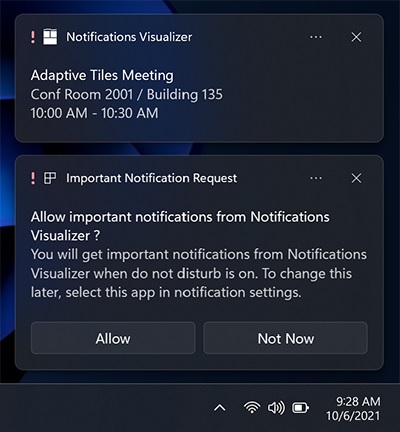
Another change made to notifications in Windows 11 is that users now have more say over which notifications are prioritized. Focus Assist (Do Not Disturb) can be overridden for truly critical alerts.
In Windows 11, you can receive critical alerts.
Apps like Visualizer have the ability to send "Allow important notifications" to users so that they can continue to receive critical alerts from the app even when Do Not Disturb mode is activated.
There will soon be a view notification button for urgent messages.
In order to protect users' privacy while using full-screen apps, Microsoft has added a new control called "view notification" to its urgent notifications feature.
One of the "worst" problems that users often encounter on Windows 10 is the black screen error.
The black screen error can occur in some situations on Windows 10, stemming from problems related to the graphics card, the connection error between the computer and your monitor, the error occurring during the installation of the operating system, updating to new versions, etc., or simply happening randomly at any time.
In the article below, the administrator will guide you with some solutions to fix the black Windows 10 screen error.
In addition, if you encounter a black screen error on Windows 7, 8, or 8.1 computers, readers can refer to the steps to fix the error here.
Steps to fix a basic black Windows 10 computer screen
1. Black screen error during installation
Once there, try turning off the computer by pressing and holding the power button for a few seconds. If using a laptop, you can unplug the charger and remove the battery.
Unplug all unnecessa...
Microsoft is currently A/B testing a native dark style for the ChatGPT-powered Bing.com, and it has finally begun distributing out Bing.com to Google Chrome and Safari. On Windows 10 and 11, we got a pop-up that allowed Bing AI access through Google Chrome. It appears that certain people can also access Bing AI through Safari.
One of the most cutting-edge and effective language models for users is Bing AI, which is powered on ChatGPT-4. Since late February, Bing.com AI support has been accessible to Microsoft Edge users. Now, Microsoft is beginning to expand its support to all browsers, including Google Chrome and Apple Safari.
Bing AI pop-up in Chrome | Image Courtesy: Thewindowsfan.com
Anyone may now test Bing AI in Chrome thanks to a new pop-up that has begun to show in the taskbar of Windows 10 or 11. In our experiments, Google Chrome's native dark mode support allowed us to access Bing AI. The screenshot below illustrates how the white background changes to a black...
Many tasks are constantly operating in the background of Windows 11, just as they were in Windows 10. File Explorer, the notification center, Settings, applications, and even the desktop are all powered by these processes. This results in a large number of processes being launched instantly upon system boot.
Third-party processes can cause issues on your desktop, but the system processes are always safe. As an example, your computer may experience lag or even freeze due to a malicious process associated with a third-party program. If a program or task is frozen, you can force it to respond by opening Task Manager, finding the program's entry, and ending the process.
In Windows 11 version 25300, Microsoft has made it possible to terminate all running processes and tasks with a single click. Windows 11 includes a new feature that can be accessed by right-clicking any app or process icon and selecting the "End Task" option.
New "End Process" button i...



Nhận xét
Đăng nhận xét