How to remove the "System Requirements Not Met" message on Windows 11
Nhận đường liên kết
Facebook
X
Pinterest
Email
Ứng dụng khác
If you are running Windows 11 on unsupported hardware, this new version of the Windows operating system will display a "System requirement not met" watermark in the bottom left corner of the screen.
This may not be a concern if you use the operating system on a virtual machine. But for most people, this message feels very uncomfortable. Fortunately, you can get rid of this annoying message by doing a trick with the Registry. Thewindowsfan.com will guide you through the following article!
Why does Windows 11 show the "System requirement not met" message?
Microsoft's Windows 11 has much stricter hardware requirements than any previous version. If your system does not meet the minimum system requirements, including TPM 2.0, the installation will stop unexpectedly.
However, this problem has many solutions. You can bypass the restriction and install Windows 11 on unsupported hardware.
Although Microsoft initially permitted installation on unsupported hardware with warnings about security issues and a lack of future updates, the company has now decided to include a permanent watermark to remind users that their system is unsupported. A similar message may also appear in the Settings app.
How to get rid of the "System requirement not met" message
If you see the "System requirement not met" watermark on your PC, you can remove it by modifying the DWORD value in Registry Editor.
Follow these steps to remove the "System requirement not met" message on Windows 11:
1. Press Win + R to open Run dialog.
2. Type regedit and press OK to open Registry Editor.
3. In Registry Editor, navigate to the following path. You can also copy and paste the path into the Registry Editor address bar for quick navigation.
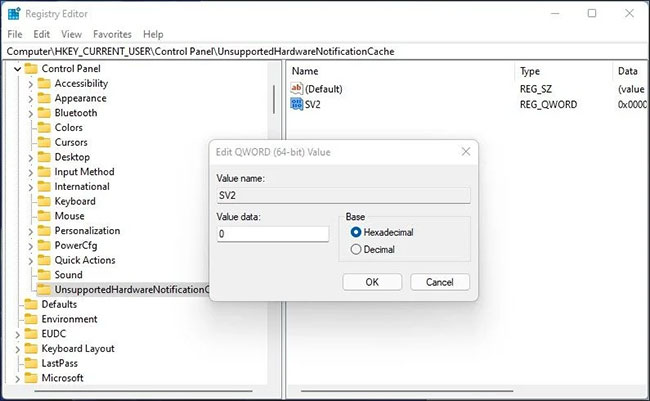
4. In the right pane, right-click the SV2 DWORD value and select Modify.
5. Enter 0 in the value data field.
Enter 0 in the value data field
6. Click OK to save the changes.
7. Close Registry Editor and restart the PC to apply the changes. After rebooting, Windows 11 will no longer display the unsupported hardware message.
If you do not have the UnsupportedHardwareNotificationCache key, you will need to create a new key and set a value for that key. To do this:
1. In the Registry Editor, right-click the Control key (HKEY_CURRENT_USERControl Panel) and select New > Key.
2. Next, rename the key to UnsupportedHardwareNotificationCache.
Create a new UnsupportedHardwareNotificationCache key
3. Next, right-click on the new key and select New > DWORD (64-bit).
4. SV2 is the new name for the value.
5. Next, modify the SV2 DWORD value and set its Value data to 2.
6. Click OK to save the changes.
Turn off the "System Requirements Not Met" message with Provided Key
Disabling the "System Requirements Not Met" message by manually interfering with the Registry can be cumbersome and, in some cases, even risky if done incorrectly. The link to the downloadable ZIP file below contains the REG file that will help you make the above changes easier and safer:
(Note: You should always be cautious with files downloaded from the Internet, especially if they are EXE (executable files) or REG files. In this case, you can open REG files in Notepad or any other plain text editor to verify that they only change the registry key specified in the article).
Download the ZIP file by clicking the link, then extract the contents anywhere you want on the system. Note that File Explorer on Windows 11 has a built-in ability to decompress ZIP files.
Right-click on the ZIP file, then click "Extract All". Follow the prompts, and a folder with the corresponding name will be created.
Now, double-click on the key named "Disable_Unsupported_Message.reg". When prompted, give the key permission to make changes to your registry.
Restart the computer after the key has been applied.
Note:There is another REG file included in the ZIP file, which, when activated, undoes the REG file "Disable_Unsupported_Message.reg" in case something doesn't work properly.
Maybe this message will reappear with new updates. So you will need to repeat the steps after installing the update.
One of the "worst" problems that users often encounter on Windows 10 is the black screen error.
The black screen error can occur in some situations on Windows 10, stemming from problems related to the graphics card, the connection error between the computer and your monitor, the error occurring during the installation of the operating system, updating to new versions, etc., or simply happening randomly at any time.
In the article below, the administrator will guide you with some solutions to fix the black Windows 10 screen error.
In addition, if you encounter a black screen error on Windows 7, 8, or 8.1 computers, readers can refer to the steps to fix the error here.
Steps to fix a basic black Windows 10 computer screen
1. Black screen error during installation
Once there, try turning off the computer by pressing and holding the power button for a few seconds. If using a laptop, you can unplug the charger and remove the battery.
Unplug all unnecessa...
Microsoft is currently A/B testing a native dark style for the ChatGPT-powered Bing.com, and it has finally begun distributing out Bing.com to Google Chrome and Safari. On Windows 10 and 11, we got a pop-up that allowed Bing AI access through Google Chrome. It appears that certain people can also access Bing AI through Safari.
One of the most cutting-edge and effective language models for users is Bing AI, which is powered on ChatGPT-4. Since late February, Bing.com AI support has been accessible to Microsoft Edge users. Now, Microsoft is beginning to expand its support to all browsers, including Google Chrome and Apple Safari.
Bing AI pop-up in Chrome | Image Courtesy: Thewindowsfan.com
Anyone may now test Bing AI in Chrome thanks to a new pop-up that has begun to show in the taskbar of Windows 10 or 11. In our experiments, Google Chrome's native dark mode support allowed us to access Bing AI. The screenshot below illustrates how the white background changes to a black...
Windows 11 is considered more beautiful and aesthetically pleasing than Windows 10. However, not everyone likes the new things that Windows 11 brings. If you have already upgraded to Windows 11 but do not like its interface and do not want to return to Windows 10, you can try the customizations below.
Customizing the interface, also known as a custom interface, is not as popular as before. However, it is still very useful in case you want to refresh your computer. In this article, the administrator will show you how to customize the Windows 11 interface to become macOS.
A video tutorial on customizing the Windows 11 interface to become macOS was made by YouTube channel Tech Rifle. To be successful, you will have to combine a variety of custom software, tools, and themes. This process requires you to perform meticulously and accurately. If only one step is wrong, the results will not be as expected, and the installation process will not be successful.
Things you need to p...


 Now, double-click on the key named "Disable_Unsupported_Message.reg". When prompted, give the key permission to make changes to your registry.
 Restart the computer after the key has been applied.
Note:There is another REG file included in the ZIP file, which, when activated, undoes the REG file "Disable_Unsupported_Message.reg" in case something doesn't work properly.
Maybe this message will reappear with new updates. So you will need to repeat the steps after installing the update.
Restart the computer after the key has been applied.
Note:There is another REG file included in the ZIP file, which, when activated, undoes the REG file "Disable_Unsupported_Message.reg" in case something doesn't work properly.
Maybe this message will reappear with new updates. So you will need to repeat the steps after installing the update.


Nhận xét
Đăng nhận xét