In Windows, you can show or hide specific fonts as needed to avoid confusion. Here is how you can do it by following simple and easy steps.
Steps to hide fonts
You must use the Fonts folder in Control Panel to hide fonts. The new Fonts page in the PC Settings app doesn't have an option to hide fonts you don't want to see.
1. First, open the Control Panel by searching in the Start menu. If you added Control Panel to the Win+X menu, you can also use it to open it.
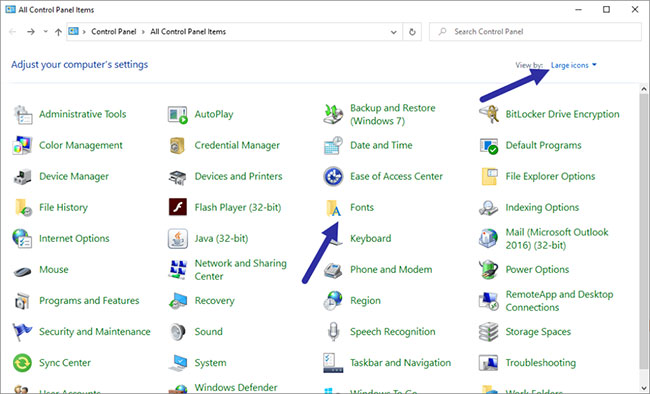
2. In the Control Panel window, set "View by" to "Large". Next, click on the "Fonts" option. This action will open the Fonts folder.
Click on the "Fonts" option
3. In the Fonts folder, find and select the font you want to hide. You can select multiple fonts by holding down the Ctrl button. When you're done selecting the font(s), click the "Hide" button that appears in the toolbar.
Find and select the font you want to hide
4. As soon as you do that, the font will fade out (become hidden).
Fonts are hidden
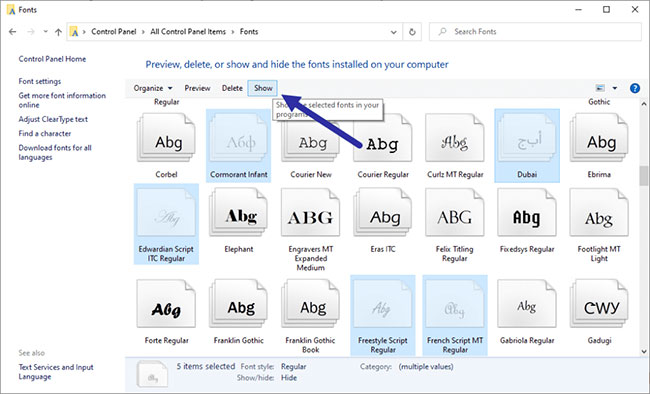
It's done! The fonts will be hidden from all programs, and you will no longer see them. However, they are not uninstalled. So if you want to show or unhide them, just select those hidden fonts and click the "Show" button.
If you want to show or unhide them, just select those hidden fonts and click the "Show" button
Hide fonts based on language settings
If you have installed multiple languages and want to hide fonts that are not designed for the current language, you can also do that. The good thing about this method is that, depending on your current language, Windows will automatically hide and unhide the fonts for the other language.
1. Search for Control Panel in the Start menu. In the Control Panel window, set View By to "Large" and select the "Fonts" option.
2. In the Fonts folder, click the "Font Settings" link on the left panel.
Click the "Font Settings" link
3. Now, select the checkbox "Hide fonts based on language settings" and click the OK button.
Select the checkbox "Hide fonts based on language settings"
From now on, Windows will automatically hide fonts that are not in the current language.
One of the "worst" problems that users often encounter on Windows 10 is the black screen error.
The black screen error can occur in some situations on Windows 10, stemming from problems related to the graphics card, the connection error between the computer and your monitor, the error occurring during the installation of the operating system, updating to new versions, etc., or simply happening randomly at any time.
In the article below, the administrator will guide you with some solutions to fix the black Windows 10 screen error.
In addition, if you encounter a black screen error on Windows 7, 8, or 8.1 computers, readers can refer to the steps to fix the error here.
Steps to fix a basic black Windows 10 computer screen
1. Black screen error during installation
Once there, try turning off the computer by pressing and holding the power button for a few seconds. If using a laptop, you can unplug the charger and remove the battery.
Unplug all unnecessa...
Microsoft is currently A/B testing a native dark style for the ChatGPT-powered Bing.com, and it has finally begun distributing out Bing.com to Google Chrome and Safari. On Windows 10 and 11, we got a pop-up that allowed Bing AI access through Google Chrome. It appears that certain people can also access Bing AI through Safari.
One of the most cutting-edge and effective language models for users is Bing AI, which is powered on ChatGPT-4. Since late February, Bing.com AI support has been accessible to Microsoft Edge users. Now, Microsoft is beginning to expand its support to all browsers, including Google Chrome and Apple Safari.
Bing AI pop-up in Chrome | Image Courtesy: Thewindowsfan.com
Anyone may now test Bing AI in Chrome thanks to a new pop-up that has begun to show in the taskbar of Windows 10 or 11. In our experiments, Google Chrome's native dark mode support allowed us to access Bing AI. The screenshot below illustrates how the white background changes to a black...
I could write a whole novel about the peculiar dilemma of maintaining visual coherence in Windows 11. A presentation and summary could be made with the help of Microsoft's Copilot, but guess what? The issue would linger, waiting for the next act.
Despite being the best operating system for productivity and gaming, Windows 11 is still not a unified system. Windows 11 may have a newer look and feel, but it still has some vestiges of older versions.
When users attempt to switch from a Microsoft account to a local one, Windows 11 still refers to the Windows 8 "Search Charm," a bizarre case of inconsistent design. When users try to switch to a local account while device encryption is enabled, they are met with the screen shown below.
" data-sizes="(max-width: 1621px) 100vw, 1621px" /> Charm Bar is mentioned in Windows 11
Windows 8's specialized 'Search Charm' has been removed from later builds of the operating system. Users are st...




Nhận xét
Đăng nhận xét