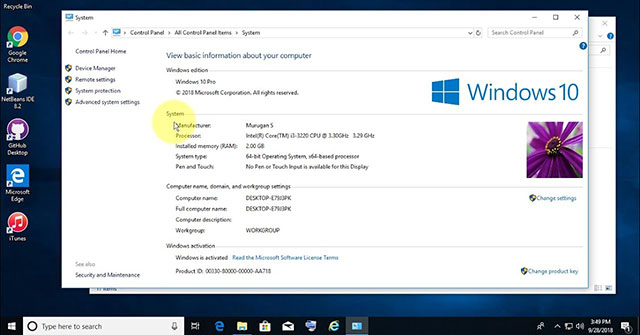
If you buy a computer or laptop from a PC manufacturer such as Dell, Sony, HP, etc., you will see their logos, contact information, model numbers, URLs, and more in the information window of the system.
Usually, these PC manufacturers are referred to as OEMs. PC manufacturers add OEM information automatically or manually to each PC they assemble. To view OEM information, search for System in the Start menu and open it. Or, right-click This PC or My Computer and select Properties. You can also use Win+Pause.
If you build your own PC, you obviously won't see all this OEM information. That means you can add your own OME name and logo with just a few clicks. Even if you are using an OEM PC, you can still change your OEM information to meet your unique needs. For example, you can replace the default OEM logo with your own photo or company logo, replace the OEM name with your own, and so on. Here's how to change OEM information in Windows 10.
Note: The same methods are applicable in Windows 7 and 8.1.
Modify the OEM name and logo
There are two ways to change OEM information in Windows 10. The first method is to use a free app. The second method is to change or create some registry keys. Do it the way you feel comfortable.
Use the free app to change OEM information
You can easily add or change the OEM name and logo using a free portable application called OEM Info Editor.
1. Download the OEM Info Editor app and run it.
2. Now, fill in all the fields. To add a logo, click the browse button (three horizontal dots) next to the Logo Path field and select the logo. Logos must be in BMP format with dimensions of 120 x 120. You can convert an image or logo to BMP format using one of these web tools.
3. Once done, click the Save button.
Click the Save button
From now on, you'll see your own custom logo and information in the System Information window.
Modify the OEM name and logo in the Windows Registry
If, for some reason, you don't want to use a third-party application, you can do the same thing by editing the Registry. All you have to do is create some new values or edit existing ones. Before making any changes, back up the registry for safekeeping.
Press Win+R, typep "regedit" and press Enter to open Windows Registry Editor.
2. Navigate to the location below to view OEM information. Windows 10 users can simply copy and paste the link below into the address bar, then press Enter.
3. If you can't see the OEM information, you need to generate an array of values. Right-click an empty space in the right panel and choose New > String Value to create a string value. You need to do it five more times for all the requested values.
Name the new values as shown below:
Logo
Manufacturer
Model
SupportURL
SupportHours
SupportPhone
4. Now, double-click each value and enter the appropriate information in the Value Data field. For example, enter your name in the Manufacturer value, the logo file path in the Logo value, a website or social network URL in the Support URL value, and so on.
Note: Logo must be in BMP format with dimensions of 120 x 120.
Once done, close the Windows Registry and reboot the system. From now on, you should see custom OEM information in the System window.
One of the "worst" problems that users often encounter on Windows 10 is the black screen error.
The black screen error can occur in some situations on Windows 10, stemming from problems related to the graphics card, the connection error between the computer and your monitor, the error occurring during the installation of the operating system, updating to new versions, etc., or simply happening randomly at any time.
In the article below, the administrator will guide you with some solutions to fix the black Windows 10 screen error.
In addition, if you encounter a black screen error on Windows 7, 8, or 8.1 computers, readers can refer to the steps to fix the error here.
Steps to fix a basic black Windows 10 computer screen
1. Black screen error during installation
Once there, try turning off the computer by pressing and holding the power button for a few seconds. If using a laptop, you can unplug the charger and remove the battery.
Unplug all unnecessa...
Microsoft is currently A/B testing a native dark style for the ChatGPT-powered Bing.com, and it has finally begun distributing out Bing.com to Google Chrome and Safari. On Windows 10 and 11, we got a pop-up that allowed Bing AI access through Google Chrome. It appears that certain people can also access Bing AI through Safari.
One of the most cutting-edge and effective language models for users is Bing AI, which is powered on ChatGPT-4. Since late February, Bing.com AI support has been accessible to Microsoft Edge users. Now, Microsoft is beginning to expand its support to all browsers, including Google Chrome and Apple Safari.
Bing AI pop-up in Chrome | Image Courtesy: Thewindowsfan.com
Anyone may now test Bing AI in Chrome thanks to a new pop-up that has begun to show in the taskbar of Windows 10 or 11. In our experiments, Google Chrome's native dark mode support allowed us to access Bing AI. The screenshot below illustrates how the white background changes to a black...
I could write a whole novel about the peculiar dilemma of maintaining visual coherence in Windows 11. A presentation and summary could be made with the help of Microsoft's Copilot, but guess what? The issue would linger, waiting for the next act.
Despite being the best operating system for productivity and gaming, Windows 11 is still not a unified system. Windows 11 may have a newer look and feel, but it still has some vestiges of older versions.
When users attempt to switch from a Microsoft account to a local one, Windows 11 still refers to the Windows 8 "Search Charm," a bizarre case of inconsistent design. When users try to switch to a local account while device encryption is enabled, they are met with the screen shown below.
" data-sizes="(max-width: 1621px) 100vw, 1621px" /> Charm Bar is mentioned in Windows 11
Windows 8's specialized 'Search Charm' has been removed from later builds of the operating system. Users are st...


Nhận xét
Đăng nhận xét