Microsoft OneDrive is a reliable cloud storage option. You can leave OneDrive to start with Windows or delay OneDrive's startup a bit. This improves Windows boot time.
You can do this by scheduling OneDrive startup using Task Scheduler. Let's learn with Thewindowsfan.com how to delay the start of OneDrive on Windows through the following article!
Delay in starting Microsoft OneDrive
There are two main steps to delaying the start of OneDrive. The first is to prevent OneDrive from starting with Windows. The second is using the Task Scheduler to schedule OneDrive to start 15 minutes after Windows starts.
Prevent OneDrive from starting with Windows
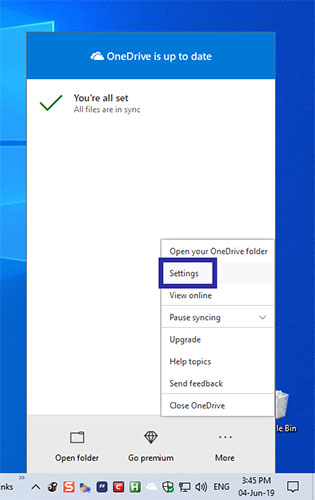
1. If OneDrive is running, right-click the OneDrive icon and select Settings.
Right-click the OneDrive icon and select Settings
2. In the Settings window, go to the Settings tab and uncheck the "Start OneDrive automatically when I sign in to Windows" option. Click the OK button to save the changes.
Schedule OneDrive startup using Task Scheduler.
3.Now, search for Task Scheduler in the Start menu and open it.
4. The Task Scheduler allows you to create custom scheduled tasks. In the Task Scheduler window, click the Create basic task option that appears on the right.
Click the Create basic task option that appears on the right
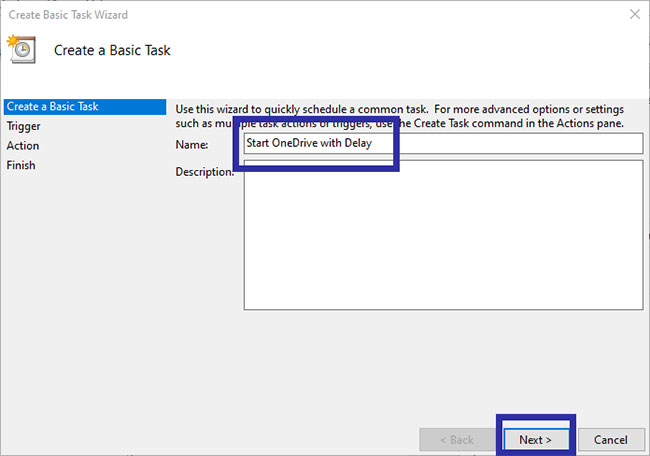
5. The above action will open the task creation wizard. Here, enter the name of your choice and click the Next button. The name in the example is Start OneDrive with delay.
Choose the name for task
6. Since you want to start OneDrive when the system boots, select the When the Computer Starts option. Click Next.
Select the When the Computer Starts option
7. Select the Start a program option and click the Next button.
Select the Start a program option
8. In the Program/Script field, enter the file path below, replacing with the actual user name. Next, add /background in the Arguments field. This argument ensures that OneDrive starts quietly, that is, the OneDrive folder won't open when it starts. Click Next.
C:UsersAppDataLocalMicrosoftOneDriveOneDrive.exe
9. Verify the summary and click the Finish button to complete the process.
10. Now you need to add a boot delay function. So, find the newly created task in the Task Scheduler, right-click on it, and select the Properties option.
Select the Properties option
11. In the Properties window, go to the Trigger tab. Now, select At Startup from the list and click on the Edit button.
Select At Startup from the list
12. Here, select the Delay task for check box and select 15 Minutes from the drop-down menu. Click the OK button to save the changes.
Select the Delay task for check box and select 15 Minutes from the drop-down menu
13. You have finished configuring the task to delay the start of OneDrive. To make sure the task will run, find the task in the Task Scheduler, right-click the task, and select the Run option.
14. The above action will trigger the task and start OneDrive. If OneDrive is running, you won't see any response. In that case, run the task again after quitting OneDrive.
See more Windows tasks that are automated with other Task Scheduler if you want.
One of the "worst" problems that users often encounter on Windows 10 is the black screen error.
The black screen error can occur in some situations on Windows 10, stemming from problems related to the graphics card, the connection error between the computer and your monitor, the error occurring during the installation of the operating system, updating to new versions, etc., or simply happening randomly at any time.
In the article below, the administrator will guide you with some solutions to fix the black Windows 10 screen error.
In addition, if you encounter a black screen error on Windows 7, 8, or 8.1 computers, readers can refer to the steps to fix the error here.
Steps to fix a basic black Windows 10 computer screen
1. Black screen error during installation
Once there, try turning off the computer by pressing and holding the power button for a few seconds. If using a laptop, you can unplug the charger and remove the battery.
Unplug all unnecessa...
Microsoft is currently A/B testing a native dark style for the ChatGPT-powered Bing.com, and it has finally begun distributing out Bing.com to Google Chrome and Safari. On Windows 10 and 11, we got a pop-up that allowed Bing AI access through Google Chrome. It appears that certain people can also access Bing AI through Safari.
One of the most cutting-edge and effective language models for users is Bing AI, which is powered on ChatGPT-4. Since late February, Bing.com AI support has been accessible to Microsoft Edge users. Now, Microsoft is beginning to expand its support to all browsers, including Google Chrome and Apple Safari.
Bing AI pop-up in Chrome | Image Courtesy: Thewindowsfan.com
Anyone may now test Bing AI in Chrome thanks to a new pop-up that has begun to show in the taskbar of Windows 10 or 11. In our experiments, Google Chrome's native dark mode support allowed us to access Bing AI. The screenshot below illustrates how the white background changes to a black...
Windows 11 is considered more beautiful and aesthetically pleasing than Windows 10. However, not everyone likes the new things that Windows 11 brings. If you have already upgraded to Windows 11 but do not like its interface and do not want to return to Windows 10, you can try the customizations below.
Customizing the interface, also known as a custom interface, is not as popular as before. However, it is still very useful in case you want to refresh your computer. In this article, the administrator will show you how to customize the Windows 11 interface to become macOS.
A video tutorial on customizing the Windows 11 interface to become macOS was made by YouTube channel Tech Rifle. To be successful, you will have to combine a variety of custom software, tools, and themes. This process requires you to perform meticulously and accurately. If only one step is wrong, the results will not be as expected, and the installation process will not be successful.
Things you need to p...



Nhận xét
Đăng nhận xét