Most home setups require the user to use a headset to make Zoom and Google Meet calls seamlessly. Gamers and music enthusiasts alike opt for headphones to get through a long day. But sometimes, Windows 10 can make you have trouble connecting your headset to your laptop or PC.
Read the following article to learn how to fix the Windows 10 headset detection problem!
1. Check audio jack
Thankfully, the tradition of removing the headphone jack has yet to make it to Windows 10 laptops. Most Windows 10 machines include a headphone jack for seamless audio output.
Before jumping to more advanced troubleshooting options, you can first check the 3.5mm audio jack on your Windows 10 computer. Make sure that the cable is connected properly for the headset to be detected successfully.
2. Check Bluetooth connection
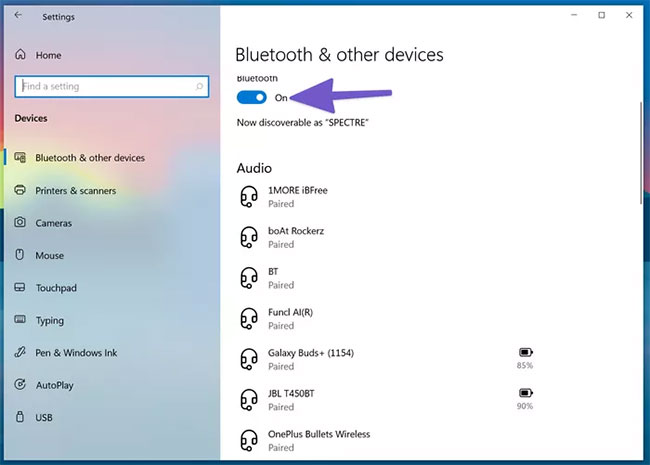
If you are using a wireless Bluetooth headset, you need to make sure that Bluetooth is enabled on Windows 10. Open the Settings app on Windows 10 (using Windows + I) and go to Devices > Bluetooth & other devices and enable Bluetooth.
Check Bluetooth connection
You can also remove the headset, which will be saved in the Bluetooth device list menu, and reconnect it.
3. Check Output Devices on Windows 10
You can select/change the default audio playback device on Windows 10. Here's how.
Step 1: Find the small sound icon on the Taskbar.
Step 2: Right-click on it and select Open Sound settings.
Step 3: In Choose your output device section, select the connected headset and you're ready.
Select the connected headset
4. Check the headset
Most headphones have a physical mute button for convenience. If you have accidentally touched it, then you will not get any audio output. Consider turning off the mute button on your headphones and enjoying the perfect sound.
6 ways to fix not recognizing SSD drive error in Windows 10
5. Check out the volume control features
You need to check the mute button and volume control options on your keyboard to see if they are in proper headphone function on Windows 10.
6. Check the headphone battery
Windows 10 operating system is smart enough to show the remaining battery life on the connected device. Here's how to check it.
Step 1: Open Settings app on Window 10 (Windows + I).
Step 2: Go to Devices menu.
Step 3: Open the Bluetooth menu and currently connected devices will be displayed.
Currently connected devices will be displayedStep 4: Notice the remaining battery life indicator next to it. If it's less than 20%, consider charging the battery or using the headphones in wired mode.
7. Select an output device in the video calling application
Most online meeting apps like Zoom, Microsoft Teams, and Google Meet allow you to select a specific audio output device from the settings menu. If you have selected the wrong output device, you will not hear anything from the connected headphones.
Let's take Zoom as an example here.
Step 1: Open Zoom app on Windows 10 device.
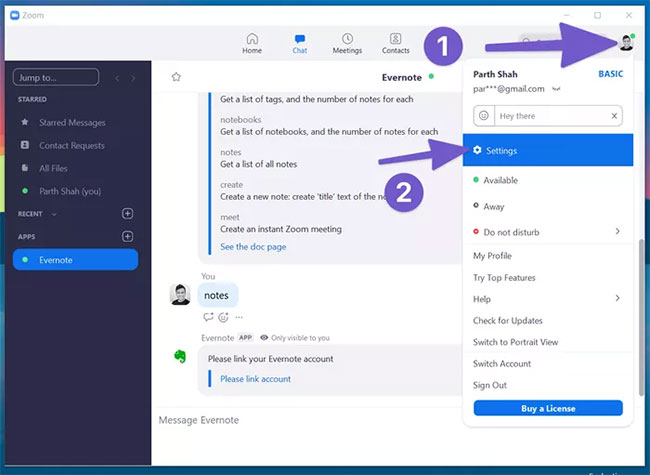
Step 2:Click the profile menu in the upper right corner.
Step 3: Select Settings from the following menu.
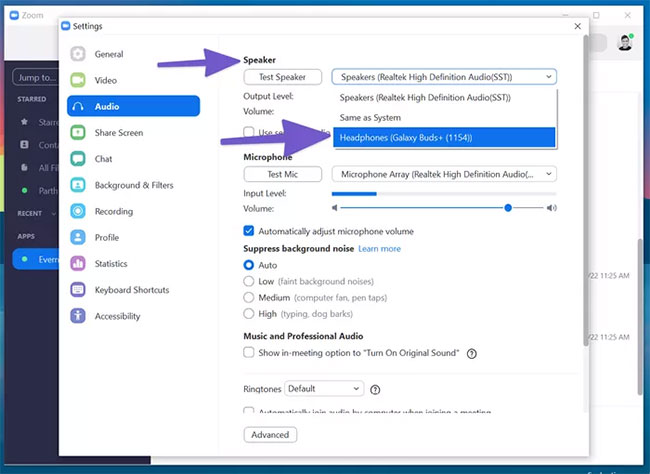
Select Settings from the menuStep 4: Go to the Audio menu.Step 5: In Speakers and Microphone menu, select the connected headset as the output device.
Select the connected headset as the output device
You can make the same changes in the Microsoft Teams and Google Meet settings menus, and then select the connected headset as the output device.
8. Use the Windows 10 troubleshoot
The default Windows 10 troubleshooter can fix annoying Bluetooth and audio-related issues on your device. Here's how to use it.
Step 1: Open Settings app on device.
Step 2: Go to Update & Security > Troubleshoot.
Step 3: Select Additional Troubleshooter.
Step 4: Troubleshoot headphones not detected using the Playing audio troubleshooter.
Troubleshoot headphones not detected using the Playing audio troubleshooter.
If this doesn't fix the problem, use the Bluetooth troubleshooter and reconnect the headset.
9.Update audio driver
Outdated audio drivers can mess up headset detection on Windows 10. You can update the relevant driver from the Device Manager app on Windows 10. Follow the steps below.
Step 1: Press Window key on the keyboard and find Device Manager.Step 2: Open Device Manager menu.
Step 3: scroll down Sound, video, and game controllers.
Step 4: Expand the menu and you will see the connected headsets from the list.
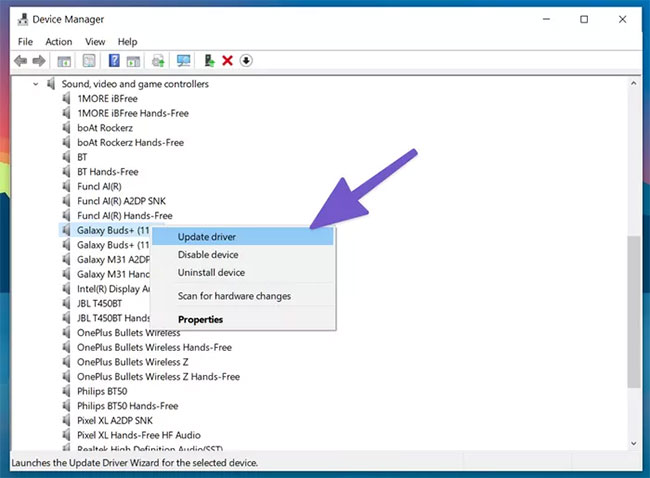
Step 5: Find the headset you want to connect and right click on it.
Step 6: Select Update drivers from the following menu.
Select Update drivers
Windows 10 will download and install the latest relevant drivers from the web.
One of the "worst" problems that users often encounter on Windows 10 is the black screen error.
The black screen error can occur in some situations on Windows 10, stemming from problems related to the graphics card, the connection error between the computer and your monitor, the error occurring during the installation of the operating system, updating to new versions, etc., or simply happening randomly at any time.
In the article below, the administrator will guide you with some solutions to fix the black Windows 10 screen error.
In addition, if you encounter a black screen error on Windows 7, 8, or 8.1 computers, readers can refer to the steps to fix the error here.
Steps to fix a basic black Windows 10 computer screen
1. Black screen error during installation
Once there, try turning off the computer by pressing and holding the power button for a few seconds. If using a laptop, you can unplug the charger and remove the battery.
Unplug all unnecessa...
Microsoft is currently A/B testing a native dark style for the ChatGPT-powered Bing.com, and it has finally begun distributing out Bing.com to Google Chrome and Safari. On Windows 10 and 11, we got a pop-up that allowed Bing AI access through Google Chrome. It appears that certain people can also access Bing AI through Safari.
One of the most cutting-edge and effective language models for users is Bing AI, which is powered on ChatGPT-4. Since late February, Bing.com AI support has been accessible to Microsoft Edge users. Now, Microsoft is beginning to expand its support to all browsers, including Google Chrome and Apple Safari.
Bing AI pop-up in Chrome | Image Courtesy: Thewindowsfan.com
Anyone may now test Bing AI in Chrome thanks to a new pop-up that has begun to show in the taskbar of Windows 10 or 11. In our experiments, Google Chrome's native dark mode support allowed us to access Bing AI. The screenshot below illustrates how the white background changes to a black...
Windows 11 is considered more beautiful and aesthetically pleasing than Windows 10. However, not everyone likes the new things that Windows 11 brings. If you have already upgraded to Windows 11 but do not like its interface and do not want to return to Windows 10, you can try the customizations below.
Customizing the interface, also known as a custom interface, is not as popular as before. However, it is still very useful in case you want to refresh your computer. In this article, the administrator will show you how to customize the Windows 11 interface to become macOS.
A video tutorial on customizing the Windows 11 interface to become macOS was made by YouTube channel Tech Rifle. To be successful, you will have to combine a variety of custom software, tools, and themes. This process requires you to perform meticulously and accurately. If only one step is wrong, the results will not be as expected, and the installation process will not be successful.
Things you need to p...






Nhận xét
Đăng nhận xét