9 ways to fix the missing Bluetooth button from Action Center in Windows 10
Nhận đường liên kết
Facebook
X
Pinterest
Email
Ứng dụng khác
In Windows 10, you can use Bluetooth to connect to headphones, webcams, and speakers, or send files and folders to other local devices. So it's inconvenient when the Bluetooth button disappears from the Action Center.
Even if Bluetooth is working properly, it may still be missing from Action Center due to incorrect settings. Another reason why Bluetooth doesn't show up in Action Center is because your system doesn't recognize Bluetooth devices.
Thankfully, there are ways to restore the Bluetooth button to the Windows 10 Action Center when it is lost or damaged.
1. Editing the Quick Actions menu
The Action Center menu is made up of two parts. At the top, it shows notifications from your installed apps and system.
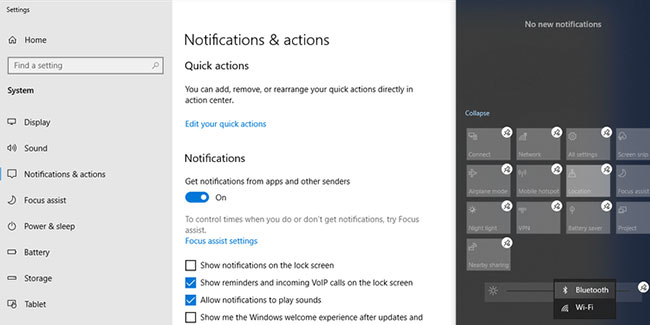
At the bottom is the Quick Actions menu, which contains shortcuts to key settings. When there are a lot of notifications that Windows 10 needs to show, it collapses the Quick Actions menu to save space. To check all the shortcuts available in the Action Center menu, click Expand.
Because not all shortcuts are enabled by default, Bluetooth may not appear in Action Center, or perhaps you accidentally disabled Bluetooth shortcuts. Whatever the reason, here's how to solve it:
Step 1: Open Action Center by pressing Windows + A, then select Manage notifications from the right top menu.
Step 2: Click Edit your quick actions. this action will open Action Center menu.
B3: Select Add > Bluetooth > Done.
Editing the Quick Actions menu
Note: When edit mode is on, you can move the tiles around as you like. If you want the Bluetooth tile to be part of the collapse menu, move it to the top row.
2. Check if your device supports Bluetooth
If you don't have the option to add Bluetooth to Action Center's quick list, it's likely that your Bluetooth driver is missing or your device doesn't support Bluetooth. Here's how you can check if Bluetooth is properly supported and configured on your device:
Step 1: Press Windows + I to open Settings, then go to Devices.
Step 2: If the Bluetooth & otherapps menu is displayed, your device supports Bluetooth technology.
Step 3: If the menu is not visible, search for device manager in the Start menu search bar and select the best match.
Step 4: Check if there is a Bluetooth menu inside the list of available devices.
Check if your device supports Bluetooth
Bluetooth might be in the list of Hidden devices, so click View > Show hidden devices and check if Bluetooth is listed.
If there is no Bluetooth in the list, you will have to purchase a Bluetooth adapter. When deciding which adapter to buy, check its compatibility properties.
3. Check Bluetooth settings
Even if the Notifications & actions settings are set properly, you still need to check the Bluetooth Settings.
Step 1: Click Start > Settings > Devices > Bluetooth & other devices.
Step 2: In Related settings, Click More Bluetooth Options.
Step 3: Select Options tab and check Show the Bluetooth icon in the notification area.
Step 4: Click Apply > OK.
Check Bluetooth settings
4. Turn off Fast Startup
Fast Startup accelerates the boot process, allowing Windows 10 to launch in less time. However, it can affect programs that are set to run at startup, so you'd better turn it off.
Step 1: Click Start > Settings > System.
Step 2: From the menu on the left, select Power & sleep.
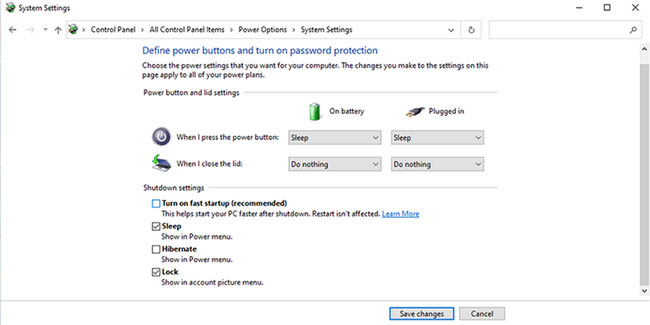
Step 3: Click Additional power settings > Choose what the power button does.
Step 4: Select Change settings that are currently unavailable.
Step 5: Unselect Turn on fast startup (recommended).
Step 6: Click Save changes button.
Turn off Fast Startup
How to change the number of Quick Actions displayed in the Action Center in Windows 10
5. Running the Bluetooth Troubleshooter
Running the troubleshooter may be enough to deal with most problems affecting Bluetooth functionality.
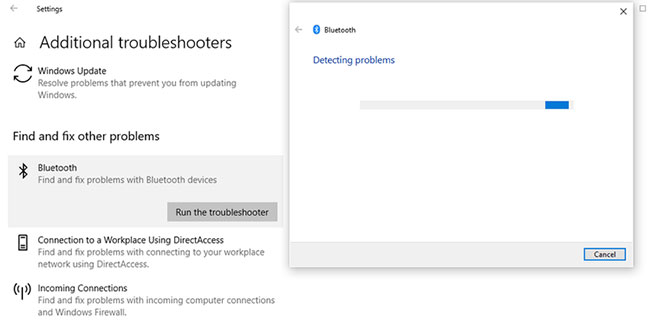
B1: Đi tới Start > Settings > Update & Security.
B2: Nhấp vào Troubleshoot > Additional troubleshooters.B3: Từ menu Find and fix other problems, nhấn Bluetooth > Run the troubleshooter.
Running the Bluetooth Troubleshooter
The Bluetooth troubleshooter will automatically fix any problems detected. Once the process is complete, restart your PC or laptop and check if Bluetooth is now available in the Action Center menu.
6. Use the Hardware and Device troubleshooter
In Windows 10, the Hardware and Device troubleshooter is now "hidden." You may still get to it, though, by using the Command Prompt. Here is how to go about it:
Step 1: In the Start menu search bar, search for command prompt and select Run as administrator.
Step 2: Type msdt.exe -id DeviceDiagnostic. This will open the troubleshooter.
Step 3: Click Next to start scanning.
Use the Hardware and Device troubleshooter
The troubleshooter will find and fix problems with your Bluetooth device. If it shows Troubleshooting couldn't identify the problem, you must try another solution.
7. Check Bluetooth Support service
A third-party application or manual action by the user may have disabled the Bluetooth Support service, removing the Bluetooth icon from the Action Center. Here's how you can check the Action Center service settings:
Step 1: The top matches in the menu's search bar
Step 2: Double-click Bluetooth Support Service to open Properties window.
Step 3: Check the Service status at the bottom of the window. It will be displayed as Running.
Step 4: If the status is Running, click Stop and Start for a quick restart.
Step 5: If the status is not Running, use the drop-down menu next to Startup Type and select Automatic.
Step 6: Click the Apply button to save the new settings.
Check Bluetooth Support service
8. Using Startup Repair
Startup Repair is one of the tools that you can find in the Advanced options menu. If you're having a problem that says the system is broken, you can fix it by using Windows Startup Repair.
Step 1: Press and hold Shift on the Windows login screen.
Step 2: Click Power > Restart. Now you will see the boot screen.
Step 3: Click Troubleshoot > Advanced options > Startup Repair.
Step 4: Select an admin account and enter the password, if required.
Step 5: Click Continue.Step 6: Restart the PC after the Startup Repair tool has run.
Using Startup Repair
9. Scan for hardware changes
Besides providing an organized view of all installed hardware, Device Manager can also be used as a troubleshooting tool.
Step 1: In the Start menu search bar, search for device manager and select the best match.
Step 2: Your device should be the first in the list. Right click on it and select Scan for hardware changes.
Scan for hardware changes
Good luck with your troubleshooting!
One of the "worst" problems that users often encounter on Windows 10 is the black screen error.
The black screen error can occur in some situations on Windows 10, stemming from problems related to the graphics card, the connection error between the computer and your monitor, the error occurring during the installation of the operating system, updating to new versions, etc., or simply happening randomly at any time.
In the article below, the administrator will guide you with some solutions to fix the black Windows 10 screen error.
In addition, if you encounter a black screen error on Windows 7, 8, or 8.1 computers, readers can refer to the steps to fix the error here.
Steps to fix a basic black Windows 10 computer screen
1. Black screen error during installation
Once there, try turning off the computer by pressing and holding the power button for a few seconds. If using a laptop, you can unplug the charger and remove the battery.
Unplug all unnecessa...
Microsoft is currently A/B testing a native dark style for the ChatGPT-powered Bing.com, and it has finally begun distributing out Bing.com to Google Chrome and Safari. On Windows 10 and 11, we got a pop-up that allowed Bing AI access through Google Chrome. It appears that certain people can also access Bing AI through Safari.
One of the most cutting-edge and effective language models for users is Bing AI, which is powered on ChatGPT-4. Since late February, Bing.com AI support has been accessible to Microsoft Edge users. Now, Microsoft is beginning to expand its support to all browsers, including Google Chrome and Apple Safari.
Bing AI pop-up in Chrome | Image Courtesy: Thewindowsfan.com
Anyone may now test Bing AI in Chrome thanks to a new pop-up that has begun to show in the taskbar of Windows 10 or 11. In our experiments, Google Chrome's native dark mode support allowed us to access Bing AI. The screenshot below illustrates how the white background changes to a black...
I could write a whole novel about the peculiar dilemma of maintaining visual coherence in Windows 11. A presentation and summary could be made with the help of Microsoft's Copilot, but guess what? The issue would linger, waiting for the next act.
Despite being the best operating system for productivity and gaming, Windows 11 is still not a unified system. Windows 11 may have a newer look and feel, but it still has some vestiges of older versions.
When users attempt to switch from a Microsoft account to a local one, Windows 11 still refers to the Windows 8 "Search Charm," a bizarre case of inconsistent design. When users try to switch to a local account while device encryption is enabled, they are met with the screen shown below.
" data-sizes="(max-width: 1621px) 100vw, 1621px" /> Charm Bar is mentioned in Windows 11
Windows 8's specialized 'Search Charm' has been removed from later builds of the operating system. Users are st...





Nhận xét
Đăng nhận xét