IIS (Internet Information Services) is always facing the Internet. So it is important to follow some rules to minimize the risk of hacking or any other security issues.
The first rule is to update the system regularly
The second principle is to create different Application Pools (containing one or more applications and allowing multiple levels of configuration between web applications). This can be done by following the steps shown below.
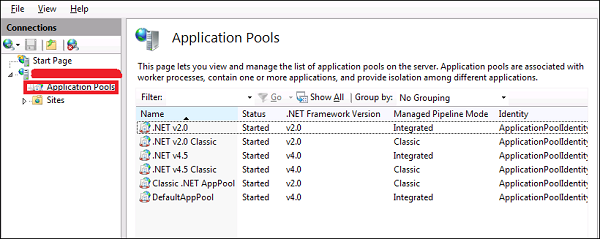
Step 1: You must access Server Manager > Internet Information Services (IIS) Manager > Application Pools.
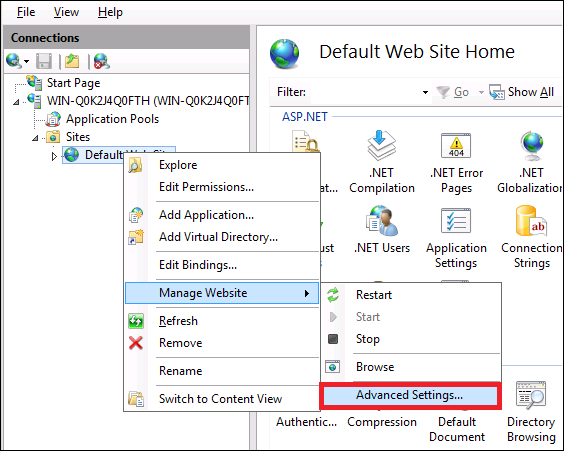
Access Server Manager > Internet Information Services (IIS) Manager > Application PoolsStep 2: Click Sites, right-click Default Website, and then select Manage Website > Advanced Settings.
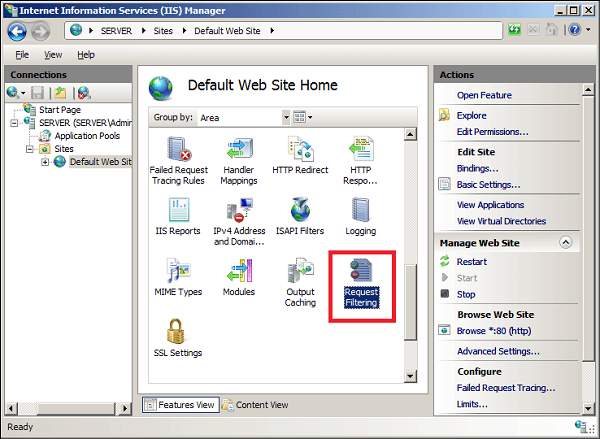
Select Manage Website > Advanced SettingsStep 3: Select Default Pools.Step 4: Disable the OPTIONS method; this can be done by going to Server Manager > Internet Information Services (IIS) Manager > Request Filtering.Go to Server Manager > Internet Information Services (IIS) Manager > Request FilteringStep 5: In the Actions panel, select Deny Verb, type OPTIONS in Verb, and then press OK.
Step 6: Enable Dynamic IP Restrictions blocks by going to IIS Manager, double-clicking on IP Address and Domain Restrictions, and then selecting the Actions panel.
Double-clicking on IP Address and Domain RestrictionsStep 7: Then select Edit Dynamic Restriction Settings, modify and set dynamic IP restriction settings as needed, and then click OK.
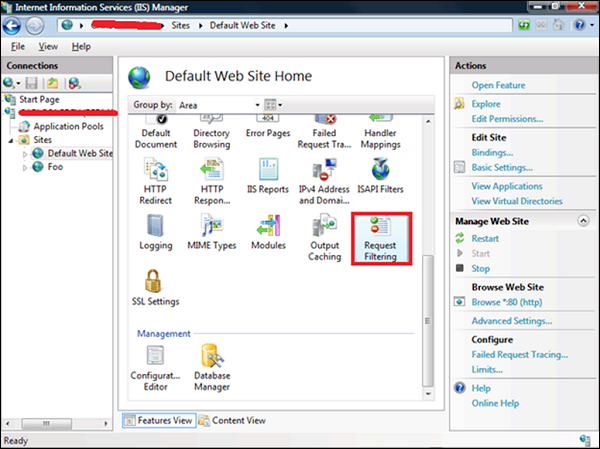
Step 8: Enable and configure Request Filtering rules. To do this, go to IIS Manager, double-click on Request Filtering, switch to the Rules tab, and then go to the Actions panel.
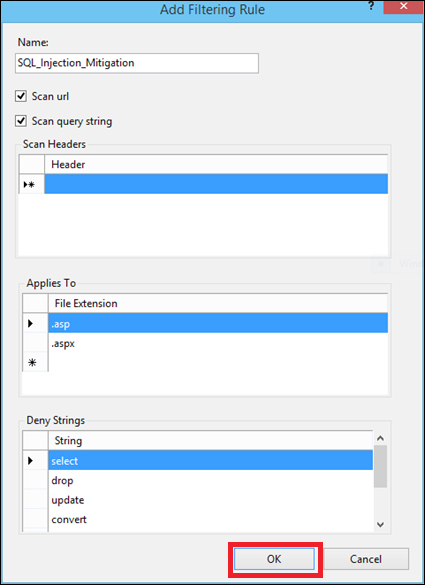
Enable and configure Request Filtering rulesStep 9: Then select Add Filtering Rule, set the required rule, and then click OK.
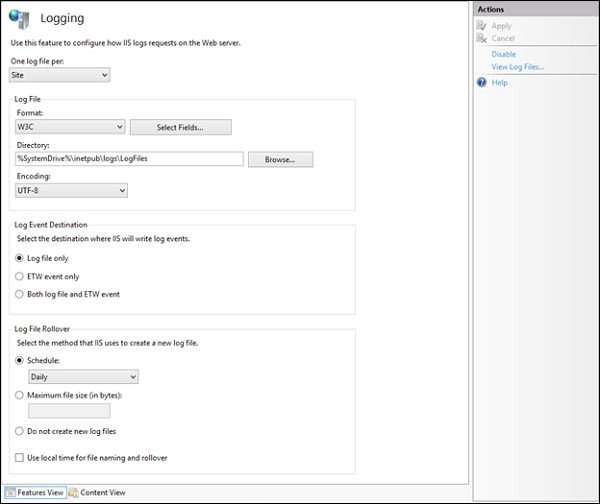
Select Add Filtering RuleStep 10: Allows logging. To do this, go to IIS Manager, select the specific site you want to configure, and then select Logging.
Allows logging
One of the "worst" problems that users often encounter on Windows 10 is the black screen error.
The black screen error can occur in some situations on Windows 10, stemming from problems related to the graphics card, the connection error between the computer and your monitor, the error occurring during the installation of the operating system, updating to new versions, etc., or simply happening randomly at any time.
In the article below, the administrator will guide you with some solutions to fix the black Windows 10 screen error.
In addition, if you encounter a black screen error on Windows 7, 8, or 8.1 computers, readers can refer to the steps to fix the error here.
Steps to fix a basic black Windows 10 computer screen
1. Black screen error during installation
Once there, try turning off the computer by pressing and holding the power button for a few seconds. If using a laptop, you can unplug the charger and remove the battery.
Unplug all unnecessa...
Microsoft is currently A/B testing a native dark style for the ChatGPT-powered Bing.com, and it has finally begun distributing out Bing.com to Google Chrome and Safari. On Windows 10 and 11, we got a pop-up that allowed Bing AI access through Google Chrome. It appears that certain people can also access Bing AI through Safari.
One of the most cutting-edge and effective language models for users is Bing AI, which is powered on ChatGPT-4. Since late February, Bing.com AI support has been accessible to Microsoft Edge users. Now, Microsoft is beginning to expand its support to all browsers, including Google Chrome and Apple Safari.
Bing AI pop-up in Chrome | Image Courtesy: Thewindowsfan.com
Anyone may now test Bing AI in Chrome thanks to a new pop-up that has begun to show in the taskbar of Windows 10 or 11. In our experiments, Google Chrome's native dark mode support allowed us to access Bing AI. The screenshot below illustrates how the white background changes to a black...
Many tasks are constantly operating in the background of Windows 11, just as they were in Windows 10. File Explorer, the notification center, Settings, applications, and even the desktop are all powered by these processes. This results in a large number of processes being launched instantly upon system boot.
Third-party processes can cause issues on your desktop, but the system processes are always safe. As an example, your computer may experience lag or even freeze due to a malicious process associated with a third-party program. If a program or task is frozen, you can force it to respond by opening Task Manager, finding the program's entry, and ending the process.
In Windows 11 version 25300, Microsoft has made it possible to terminate all running processes and tasks with a single click. Windows 11 includes a new feature that can be accessed by right-clicking any app or process icon and selecting the "End Task" option.
New "End Process" button i...




Nhận xét
Đăng nhận xét