Window error 0x800705b4 is actually an issue with the Windows Update service, where Windows Update cannot complete its task for some reason.
Keeping Windows up to date is paramount if you want to get new features and, more importantly, the latest security patches. Sometimes Windows update errors come from you and can also be due to Windows errors.
What is error 0x800705b4?
Windows update error 0x800705b4 is a weird one. It usually appears when you try to complete a Windows update or if the update scheduler fires at the specified time.
There are several causes for the error, namely an issue with the service itself and Windows Defender getting in the way. But narrowing down the root of error 0x800705b4 involves trying many different fixes, so the article won't focus on the symptoms but on potential fixes instead.
How to fix Windows 10 update error 0x800705b4
There are a few different ways you can try to update Windows 10 properly. Nothing is too complicated. We'll start with the easiest and most likely way to succeed:
Note: After each fix, you should restart the system and try to update Windows again.
1. Run a virus scan: This seems unlikely, but sometimes Windows errors can be caused by malicious software such as viruses and malware. Running a virus scan can help fix that. If you haven't already, you can install an antivirus application and then run it to make sure nothing nefarious is lurking in the system.
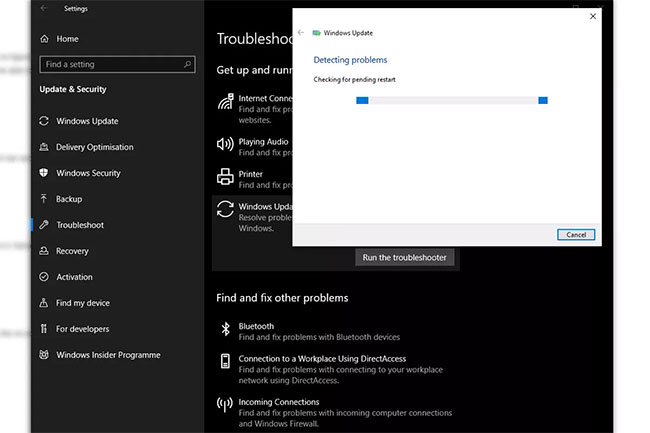
2. Run the Windows Update Troubleshooter: The Windows troubleshooter is a great way to try to figure out what's wrong with your system. Even if the tool doesn't fix the error, it can point you in the right direction.
Run the Windows Update Troubleshooter
3. Reset Windows Update: It is possible that certain components of the Windows Update process were corrupted for some reason. There is an automated script that you can run (you can download the script from Microsoft). If you prefer, you can also run the manual update process.
4. Run the System File Checker scan: Another way to potentially fix this update problem is to use a file checker app. It can be activated with a simple command: sfc/scannow. There are also a few other sfc commands worth learning if you're interested in the versatility of this tool.
5. Run a DISM scan: You can also try running a Deployment Image Servicing and Management (DISM) scan. This tool is less likely to troubleshoot than the methods above, but it is easy to use and can fix some potential problems.
6. Change Windows Update settings: It's possible that an unnecessary Windows component in the update is preventing it from downloading. Focusing only on the critical elements of Windows can fix that. Remember, if you disable Windows Automatic Updates, be sure to turn them back on again when your issue is resolved so you don't miss any important security updates.
7. Disable anti-virus software: This should only be tried if you've done everything else. Please keep in mind that this should only be a temporary measure. You must reactivate your anti-virus software once the update is complete, as it is paramount to staying safe online.
One of the "worst" problems that users often encounter on Windows 10 is the black screen error.
The black screen error can occur in some situations on Windows 10, stemming from problems related to the graphics card, the connection error between the computer and your monitor, the error occurring during the installation of the operating system, updating to new versions, etc., or simply happening randomly at any time.
In the article below, the administrator will guide you with some solutions to fix the black Windows 10 screen error.
In addition, if you encounter a black screen error on Windows 7, 8, or 8.1 computers, readers can refer to the steps to fix the error here.
Steps to fix a basic black Windows 10 computer screen
1. Black screen error during installation
Once there, try turning off the computer by pressing and holding the power button for a few seconds. If using a laptop, you can unplug the charger and remove the battery.
Unplug all unnecessa...
Microsoft is currently A/B testing a native dark style for the ChatGPT-powered Bing.com, and it has finally begun distributing out Bing.com to Google Chrome and Safari. On Windows 10 and 11, we got a pop-up that allowed Bing AI access through Google Chrome. It appears that certain people can also access Bing AI through Safari.
One of the most cutting-edge and effective language models for users is Bing AI, which is powered on ChatGPT-4. Since late February, Bing.com AI support has been accessible to Microsoft Edge users. Now, Microsoft is beginning to expand its support to all browsers, including Google Chrome and Apple Safari.
Bing AI pop-up in Chrome | Image Courtesy: Thewindowsfan.com
Anyone may now test Bing AI in Chrome thanks to a new pop-up that has begun to show in the taskbar of Windows 10 or 11. In our experiments, Google Chrome's native dark mode support allowed us to access Bing AI. The screenshot below illustrates how the white background changes to a black...
Windows 11 is considered more beautiful and aesthetically pleasing than Windows 10. However, not everyone likes the new things that Windows 11 brings. If you have already upgraded to Windows 11 but do not like its interface and do not want to return to Windows 10, you can try the customizations below.
Customizing the interface, also known as a custom interface, is not as popular as before. However, it is still very useful in case you want to refresh your computer. In this article, the administrator will show you how to customize the Windows 11 interface to become macOS.
A video tutorial on customizing the Windows 11 interface to become macOS was made by YouTube channel Tech Rifle. To be successful, you will have to combine a variety of custom software, tools, and themes. This process requires you to perform meticulously and accurately. If only one step is wrong, the results will not be as expected, and the installation process will not be successful.
Things you need to p...


Nhận xét
Đăng nhận xét