How to fix "This App Can't Run on Your PC" error on Windows 10
Nhận đường liên kết
Facebook
X
Pinterest
Email
Ứng dụng khác
If Windows 10 shows the "This App Can't Run on Your PC" error, there could be a few reasons behind this problem. Sometimes the application is not compatible with your system, you are logged in with the wrong user account, or the settings are faulty.
Luckily, there are several fixes you can try. Let's look at the following TheWindowsFan.com article to see how to fix the "This App Can't Run on Your PC" error on Windows 10.
1. Check the app's version
If you have downloaded and installed an application without checking its properties, it may not be compatible with the system. For example, you cannot run an application that is compatible with the 32-bit version of Windows 10 and have it run smoothly on a 64-bit system.
Before downloading the application, you should review the system properties. Press Win + I to open Settings and select System. Then, from the menu on the left, click About.
The Device specifications section will give you information about your system, including the version of Windows you have installed on your computer.
2. Run the application in Compatibility Mode
You may get a "This app can't run on your PC" error when trying to run an old app. To fix it, you should enable Compatibility Mode from the app's properties.
Right-click the application's executable file and select Properties. Open the Compatibility tab, select Run this program in compatibility mode for, and select another version of Windows using the drop-down menu. Click Apply > OK to save the new settings and try running the application.
3. Run a copy of the executable
This is a bit of a strange trick, but it can be helpful in fixing the error. Copy the application's executable file and paste it in a new location. Then run the copied file as you normally would.
4. Scan virus
Viruses can prevent an application from running as it should, even if it is compatible with the system. You can use Windows' built-in tools to search for any viruses on your computer. Here's how you can do it:
Step 1: Right-click on Start and go to Settings > Update & Security.
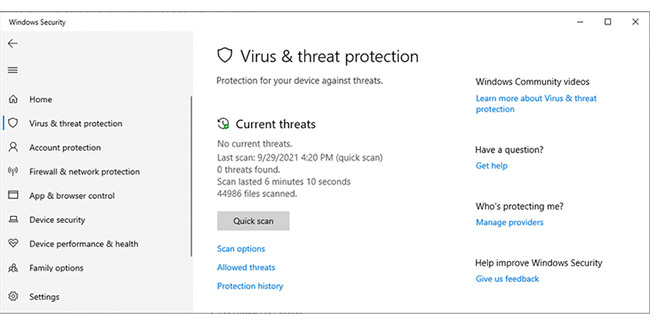
Step 2: From the left menu, open Windows Security and click Virus & threat protection.
Step 3: Click the Quick scan button and wait until Windows 10 finishes the process.
Viruses can prevent apps from running as they should
5. Running an SFC scan
If the Quick scan tool doesn't fix the problem, there's another Windows 10 feature you can use. The System File Checker tool will search for any corrupted system files and automatically replace them.
Open Command Prompt with administrative privileges and type sfc /scannow. To start the process, just press Enter. When the SFC scan is complete, it will display a message letting you know if it has found and replaced corrupted files on the system.
6. Using the Disk Cleanup tool
Your computer often accumulates junk files, especially if you browse the Internet a lot. If these files take up a lot of space on the hard drive, they can cause application errors. The easiest way to delete these unnecessary files is to use Disk Cleanup.
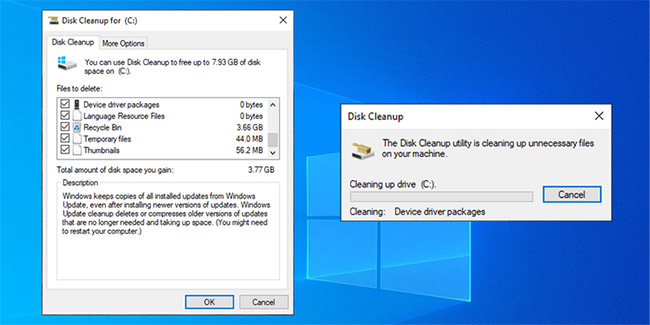
Step 1: In the Start menu search bar, search for disk cleanup and select Run as administrator.
Step 2: Select the file you want to delete. Disk Cleanup will tell you how much space is reclaimed.
Step 3: Click OK to start the process.
Junk files can cause application errors
7. Reinstall the problematic app
If you're still getting the "This app can't run on your PC" error after trying everything on this list, you should reinstall the app. After you uninstall, go to the official website and download the latest version.
However, remember to clear your browser's cache before reloading any files. Browser caching makes browsing faster and reduces server latency by downloading website data. However, your browser's cache can corrupt downloads on your computer.
This error is not limited to third-party apps; it can also occur when attempting to launch apps downloaded from the Microsoft Store. To prevent this from happening again, download the app from the official websites and constantly check the app and system for new updates.
One of the "worst" problems that users often encounter on Windows 10 is the black screen error.
The black screen error can occur in some situations on Windows 10, stemming from problems related to the graphics card, the connection error between the computer and your monitor, the error occurring during the installation of the operating system, updating to new versions, etc., or simply happening randomly at any time.
In the article below, the administrator will guide you with some solutions to fix the black Windows 10 screen error.
In addition, if you encounter a black screen error on Windows 7, 8, or 8.1 computers, readers can refer to the steps to fix the error here.
Steps to fix a basic black Windows 10 computer screen
1. Black screen error during installation
Once there, try turning off the computer by pressing and holding the power button for a few seconds. If using a laptop, you can unplug the charger and remove the battery.
Unplug all unnecessa...
Microsoft is currently A/B testing a native dark style for the ChatGPT-powered Bing.com, and it has finally begun distributing out Bing.com to Google Chrome and Safari. On Windows 10 and 11, we got a pop-up that allowed Bing AI access through Google Chrome. It appears that certain people can also access Bing AI through Safari.
One of the most cutting-edge and effective language models for users is Bing AI, which is powered on ChatGPT-4. Since late February, Bing.com AI support has been accessible to Microsoft Edge users. Now, Microsoft is beginning to expand its support to all browsers, including Google Chrome and Apple Safari.
Bing AI pop-up in Chrome | Image Courtesy: Thewindowsfan.com
Anyone may now test Bing AI in Chrome thanks to a new pop-up that has begun to show in the taskbar of Windows 10 or 11. In our experiments, Google Chrome's native dark mode support allowed us to access Bing AI. The screenshot below illustrates how the white background changes to a black...
Many tasks are constantly operating in the background of Windows 11, just as they were in Windows 10. File Explorer, the notification center, Settings, applications, and even the desktop are all powered by these processes. This results in a large number of processes being launched instantly upon system boot.
Third-party processes can cause issues on your desktop, but the system processes are always safe. As an example, your computer may experience lag or even freeze due to a malicious process associated with a third-party program. If a program or task is frozen, you can force it to respond by opening Task Manager, finding the program's entry, and ending the process.
In Windows 11 version 25300, Microsoft has made it possible to terminate all running processes and tasks with a single click. Windows 11 includes a new feature that can be accessed by right-clicking any app or process icon and selecting the "End Task" option.
New "End Process" button i...



Nhận xét
Đăng nhận xét