8 ways to fix malfunctioning screensavers in Windows 10
Nhận đường liên kết
Facebook
X
Pinterest
Email
Ứng dụng khác
Windows comes with a lot of personalization options, one of which is screensavers. You can place any design, image, or text to add some fun to your screen during a break. However, sometimes screensavers stop working, leaving you with a blank and boring screen.
If your computer does not display screensavers no matter how long you wait, the following guide from Thewindowsfan.com will help you fix this. In addition, the article will also guide you on what to do when the screensaver freezes or when you cannot exit the screensaver mode.
1. Turn on screensavers via Settings
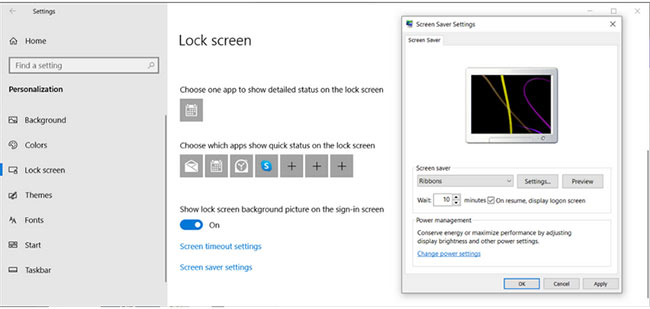
By default, Windows screensavers are disabled. So, if you don't recall configuring this setting, you'll probably need to enable it in Windows settings. Follow these steps to enable the screensaver and personalize it:
Step 1: By pressing Windows key + I, you can access Settings.
Step 2: Go to Personalization.Step 3: Select Lock screen from the menu on the left.
Step 4: Click Screen saver settings.
Step 5: Use the Screen saver drop-down menu to select screensavers. You can check the appearance of screensavers by clicking Preview.
Step 6: Use the field next to Wait to set after how many minutes of screen inactivity the screensaver will start working.
Step 7: Click Apply > OK to save the new screensaver settings.
Turn on screensavers via Settings
If you want to lock your computer when the screensaver starts, select the option On resume, display the logon screen. Also, set the timeout to one or two minutes when you turn on the screensaver for the first time so you can check if it works properly.
Note: If you have not activated Windows, you cannot adjust the settings of screensavers.
2. Disconnect any external devices that you no longer need
If you have a screensaver set up and it doesn't activate, try removing some devices that you no longer use. External devices such as joysticks, cameras, or headsets may prevent the system from activating screensavers.
If you've unplugged all unnecessary devices and your screensavers still won't start, you should look into other options.
3. Change the time the computer goes to sleep
If the computer takes less time to go to sleep than it takes to activate the screensaver, you will never see the screensaver. This is because your computer was in sleep mode before the screensaver was activated.
To fix it, you need to adjust the time the computer goes to sleep or the screensaver timeout. Follow the steps outlined above to change the screensaver timeout. If you want to adjust how long the computer goes to sleep, follow these steps:
Step 1: Open Settings.Step 2: Go to System > Power & sleep.
Step 3: Under Sleep, use the drop-down menu to set a new time.
Change the time the computer goes to sleepNote: Set a new time for both the On battery power, PC goes to sleep after and When plugged in, PC goes to sleep after options.
4. Examine the Presentation settings
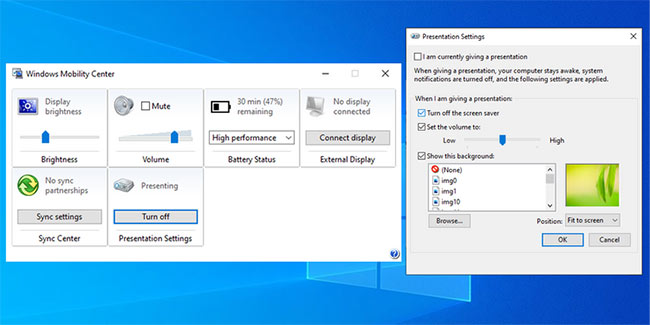
Windows has many tricks up its sleeve that you may not be aware of, and Presentation mode could be one of them. While this is great for business environments as it doesn't interrupt your speech, it will also turn off screensavers.
To disable Presentation mode, right-click Start and go to Mobility Center. Then, click the Turn Off button under Presenting. If you want to check more settings, click the Projector icon.
Examine the Presentation settings
5. Run Power troubleshooter
If you can't find anything wrong with the screensaver settings, it's time to turn to Windows troubleshooting tools. Running the Power troubleshooter can fix problems with screensavers.
Step 1: Click on Start and go to Settings > Update & Security.Step 2: From the left, select Troubleshooter.Step 3: Click on Additional troubleshooters.Step 4: Go to Find and fix other problems.
Step 5: Click on Power > Run the troubleshooter.Run Power troubleshooter
The troubleshooter will fix any problems found on its own. Then check if the screensaver is working or not.
6. Run an SFC scan
System File Checker will repair any corrupted system files or problems that prevent screensavers from functioning properly. Launch the Command Prompt with admin rights and use the sfc /scannow command to start the scan.
This can take a while, so make sure you or anyone else doesn't close the Command Prompt window. If any corrupted or problematic files are found, SFC will automatically replace them.
7. Reset power plan settings
Because screensavers are a power feature, some incorrect power settings may prevent screensavers from activating. In this case, reverting the power plan settings to default will fix the problem. Here's how you can do it:
Step 1: Open Control Panel.
Step 2: From View by menu, select Large icons or Small icons.Step 3: Open Power options.Step 4: Click on Change plan settings > Restore default settings for this plan.
Reset power plan settings
8. Update the monitor's driver
If your computer screensaver works but freezes, you should update your display driver.
Although graphics card drivers are usually updated through Windows updates, it is likely that you are using drivers that are not included in Windows updates.
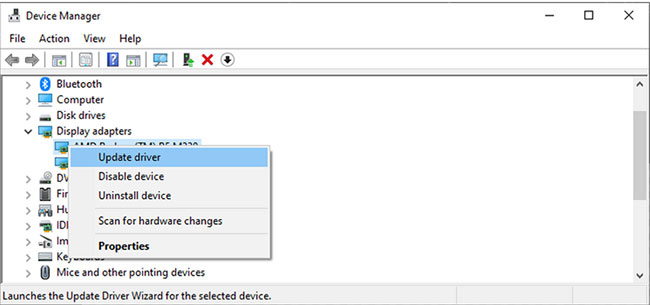
In this case, you can update the display driver manually through Device Manager. Here's how you can do it:
Step 1: Type device manager in the Start menu search bar and select Best match.
Step 2: Expand the list of Display adapters.
Step 3: Select Update driver from the context menu when you right-click on the graphics driver.
Step 4: In the pop-up window, select Search automatically for drivers.
Update the monitor's driver
You can also find available updates on the manufacturer's website, as long as you make sure you're installing one that's compatible with your system.
Good luck with your troubleshooting!
One of the "worst" problems that users often encounter on Windows 10 is the black screen error.
The black screen error can occur in some situations on Windows 10, stemming from problems related to the graphics card, the connection error between the computer and your monitor, the error occurring during the installation of the operating system, updating to new versions, etc., or simply happening randomly at any time.
In the article below, the administrator will guide you with some solutions to fix the black Windows 10 screen error.
In addition, if you encounter a black screen error on Windows 7, 8, or 8.1 computers, readers can refer to the steps to fix the error here.
Steps to fix a basic black Windows 10 computer screen
1. Black screen error during installation
Once there, try turning off the computer by pressing and holding the power button for a few seconds. If using a laptop, you can unplug the charger and remove the battery.
Unplug all unnecessa...
Microsoft is currently A/B testing a native dark style for the ChatGPT-powered Bing.com, and it has finally begun distributing out Bing.com to Google Chrome and Safari. On Windows 10 and 11, we got a pop-up that allowed Bing AI access through Google Chrome. It appears that certain people can also access Bing AI through Safari.
One of the most cutting-edge and effective language models for users is Bing AI, which is powered on ChatGPT-4. Since late February, Bing.com AI support has been accessible to Microsoft Edge users. Now, Microsoft is beginning to expand its support to all browsers, including Google Chrome and Apple Safari.
Bing AI pop-up in Chrome | Image Courtesy: Thewindowsfan.com
Anyone may now test Bing AI in Chrome thanks to a new pop-up that has begun to show in the taskbar of Windows 10 or 11. In our experiments, Google Chrome's native dark mode support allowed us to access Bing AI. The screenshot below illustrates how the white background changes to a black...
Many tasks are constantly operating in the background of Windows 11, just as they were in Windows 10. File Explorer, the notification center, Settings, applications, and even the desktop are all powered by these processes. This results in a large number of processes being launched instantly upon system boot.
Third-party processes can cause issues on your desktop, but the system processes are always safe. As an example, your computer may experience lag or even freeze due to a malicious process associated with a third-party program. If a program or task is frozen, you can force it to respond by opening Task Manager, finding the program's entry, and ending the process.
In Windows 11 version 25300, Microsoft has made it possible to terminate all running processes and tasks with a single click. Windows 11 includes a new feature that can be accessed by right-clicking any app or process icon and selecting the "End Task" option.
New "End Process" button i...






Nhận xét
Đăng nhận xét