6 Ways to Fix the Media Creation Tool When It's Not Working
Nhận đường liên kết
Facebook
X
Pinterest
Email
Ứng dụng khác
The Media Creation Tool allows you to reinstall Windows using a USB or DVD. It is basically a hard copy of Windows that can be used when your current installation of Windows is corrupted and the operating system is not working properly. However, this tool is also prone to annoying errors, especially if they happen right before the installation process.
If you find yourself in a situation like this, the following article lists some effective fixes that you can try to get the Media Creation Tool working as before.
1. Run the Media Creation Tool with admin rights
One of the most common problems preventing the Media Creation Tool from working correctly is a lack of permissions. In some cases, applications require admin rights to run, and when that access is missing, they generate errors.
The fix in this case is very simple, because all you need to do is run the Media Creation Tool with admin rights. Here's how to do it:
Step 1: Plug in the bootable USB and right-click the Media Creation Tool icon on the desktop.
Step 2: Select Run as administrator from the context menu.
Select Run as administratorStep 3: Click Yes in the User Account Control prompt to continue.
Click Yes
If you are unable to use the Media Creation Tool due to insufficient permissions, running it with admin rights should help you fix the problem.
2. Modify the Windows Registry
You may also need to tweak the Registry Editor slightly to run the Media Creation Tool successfully.
The Windows Registry is an administrative tool that stores information about programs and processes in Windows. Most, if not all, of the changes (like installing an application or granting additional permissions to a program) that you make in Windows are logged in the Registry.
Since the Registry is an important utility that is normally only used by administrators, make sure that you make a backup of the Registry before making any kind of edits in it. Also, keep in mind that you need to be logged into Windows with admin rights to perform the steps below:
Step 1: Press Win + R to open Run.
Step 2: Type regedit into Run and click Enter.Step 3: Click Yes in the confirmation prompt.
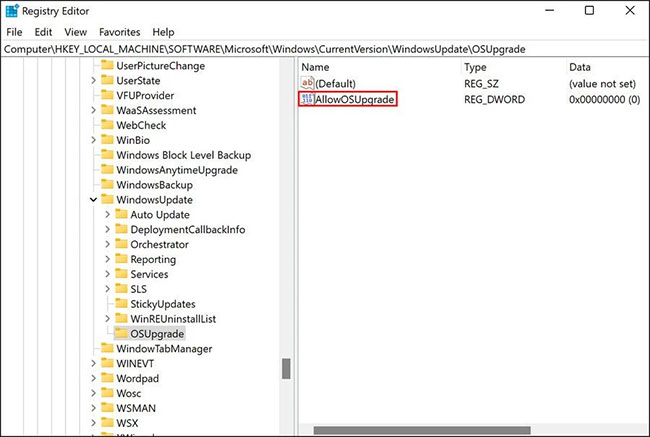
Click Yes in the confirmation promptStep 4: Inside Registry Editor, go to the location mentioned below:
Step 5: Right-click the OSUpgrade key and select the New > DWORD (32-bit) Value option.
Right-click the OSUpgrade keyStep 6: Name this value AllowOSUpgrade.
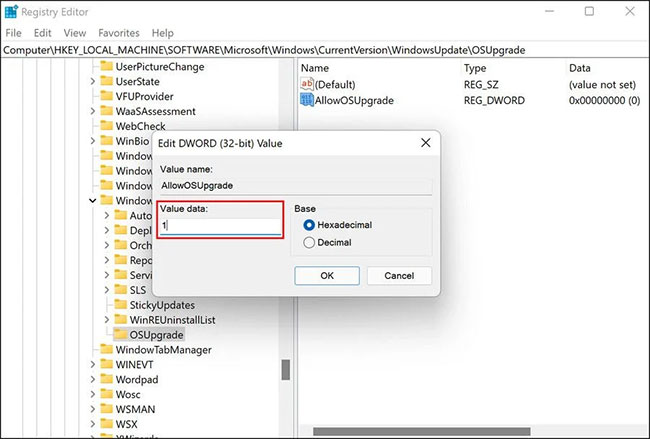
Name this value AllowOSUpgradeStep 7: Double-click AllowOSUpgrade and enter 1 in the Value data field.
Set Value data is 1Step 8: Click OK and close Registry Editor.
Now you can restart your computer and check if you can use the Media Creation Tool now.
3. Enable relevant services
Some programs on Windows need related services to work properly. In order for the Media Creation Tool to run without any problems, the following services must be enabled:
Background Intelligent Transfer Service (BITS)
Server
TCP/IP NetBIOS Helper
Workstation
IKE and AuthIP IPsec Keying Modules
Windows Update or Automatic Updates
If one or more of these services are disabled, you may have problems using the Media Creation Tool. Follow the steps below to enable these services:
Step 1: Press Win + R to open Run.Step 2: Type services.msc into Run and click Enter.Step 3: In the following window, find Background Intelligent Transfer Service (BITS) and right-click on it.
Step 4: Select Properties from the context menu.
Select PropertiesStep 5: In the Properties dialog box, click the Start button. If the service is already running, you can restart it by first stopping it and then restarting it.
Click the Start buttonStep 6: Set Startup type to Automatic.Set Startup type to AutomaticStep 7: Perform the same steps with the other services that the article mentions above.
Step 8: Once done, close the Services window and check if you can use the Media Creation Tool without any problems now.
4. Make sure you are running the latest version of Windows
It is critical to keep your Windows up to date. The latest updates provide many new features and ensure that your system and its applications are always compatible with each other. Most updates also come with security patches and bug fixes that can help you solve many problems in Windows without much input.
Update Windows
You may have problems with the Media Creation tool if your version of Windows is out of date. If that's the case, install the latest updates to fix the problem.
5. Check system memory
You should have at least 8 GB of free space on your computer's hard drive to use the Media Creation Tool. Also, your USB should have the same amount of free space to avoid any storage problems in the process.
If the storage space is less than the recommended free space, you can delete some unimportant Windows files and folders to free up computer space.
6. Reinstall the Media Creation Tool
Finally, if the troubleshooting methods mentioned above don't help, then it's likely that the problem is with the Media Creation Tool itself and not with the system.
In this case, the only possible solution is to uninstall the Media Creation Tool and reinstall it from scratch. You can uninstall the current version from the USB and then reinstall it from the official Microsoft website.
Installing Windows on a USB drive or disk can be quite useful in cases of errors that the operating system cannot fix on its own. However, a faulty Media Creation Tool itself can lead to a slightly more complicated situation.
The methods mentioned above will hopefully be of help to you if you face any such problem along the way. If you are still having problems even after trying the above troubleshooting techniques, the article recommends that you contact Microsoft support and report the problem to them.
One of the "worst" problems that users often encounter on Windows 10 is the black screen error.
The black screen error can occur in some situations on Windows 10, stemming from problems related to the graphics card, the connection error between the computer and your monitor, the error occurring during the installation of the operating system, updating to new versions, etc., or simply happening randomly at any time.
In the article below, the administrator will guide you with some solutions to fix the black Windows 10 screen error.
In addition, if you encounter a black screen error on Windows 7, 8, or 8.1 computers, readers can refer to the steps to fix the error here.
Steps to fix a basic black Windows 10 computer screen
1. Black screen error during installation
Once there, try turning off the computer by pressing and holding the power button for a few seconds. If using a laptop, you can unplug the charger and remove the battery.
Unplug all unnecessa...
Microsoft is currently A/B testing a native dark style for the ChatGPT-powered Bing.com, and it has finally begun distributing out Bing.com to Google Chrome and Safari. On Windows 10 and 11, we got a pop-up that allowed Bing AI access through Google Chrome. It appears that certain people can also access Bing AI through Safari.
One of the most cutting-edge and effective language models for users is Bing AI, which is powered on ChatGPT-4. Since late February, Bing.com AI support has been accessible to Microsoft Edge users. Now, Microsoft is beginning to expand its support to all browsers, including Google Chrome and Apple Safari.
Bing AI pop-up in Chrome | Image Courtesy: Thewindowsfan.com
Anyone may now test Bing AI in Chrome thanks to a new pop-up that has begun to show in the taskbar of Windows 10 or 11. In our experiments, Google Chrome's native dark mode support allowed us to access Bing AI. The screenshot below illustrates how the white background changes to a black...
Many tasks are constantly operating in the background of Windows 11, just as they were in Windows 10. File Explorer, the notification center, Settings, applications, and even the desktop are all powered by these processes. This results in a large number of processes being launched instantly upon system boot.
Third-party processes can cause issues on your desktop, but the system processes are always safe. As an example, your computer may experience lag or even freeze due to a malicious process associated with a third-party program. If a program or task is frozen, you can force it to respond by opening Task Manager, finding the program's entry, and ending the process.
In Windows 11 version 25300, Microsoft has made it possible to terminate all running processes and tasks with a single click. Windows 11 includes a new feature that can be accessed by right-clicking any app or process icon and selecting the "End Task" option.
New "End Process" button i...




Nhận xét
Đăng nhận xét