Does your Windows computer shut down without warning or crash every time you try to wake it up from sleep mode? If so, your computer may have encountered a power failure that caused it to crash without warning.
This problem is called a Kernel-Power bug, which seems to have no reason but is a serious system problem.
Here's how you can fix Kernel-Power Event ID 41 and prevent your computer from crashing.
1. Windows 10 Update
Check if Windows 10 is updated. Microsoft releases updates for Windows 10 regularly, fixing bugs and other issues. The fatal Kernel-Power error could be caused by a bug that was fixed in the update.
Press Win+I, type update in the search box, and select Check for updates. If there is an update pending, download and install it, then reboot the system.
2. Disable Windows 10 Fast Startup
Windows 10 Fast Startup is a sleep mode that allows the computer to start up extremely fast. Windows 10 activates Fast Startup by default during installation. If you enable Fast Startup, the computer will not shut down completely.
It enters a state that combines full shutdown with hibernation, saving the most recent machine state to let you start working right away.
However, unlike full hibernation, when you go back to Windows 10, everything is like starting the machine from scratch. No windows or applications are open, etc.
Disable Windows 10 Fast Startup
To turn off Fast Startup, type power set in the Start menu search bar, then select Choose a power plan.
Now, select Choose what the power buttons do, followed by Change settings that are currently unavailable.
Uncheck Turn on fast start-up and click Save changes.
3. Reconnect the RAM and the graphics card
Some users reported the Kernel-Power 41 error after reattaching RAM and the graphics card (GPU).
You will have to go inside the computer to reattach the hardware. Please be aware that in some cases, doing this will void the manufacturer's warranty, so proceed with caution.
4. Run CHKDSK and SFC
CHKDSK is a Windows system tool that you can use to verify your Windows 10 file system. You can add specific options to find and correct errors as the tool runs. Run it from the Command Prompt, then use the CHKDSK scan to find and fix the problem.
1. Open Command Prompt with administrative privileges.
2. Next, type chkdsk /r and press Enter. The command will scan the system for errors and fix any problems.
If CHKDSK does not find any errors, you can run Windows System File Check (SFC). Windows System File Check is another Windows tool that you can use to check for missing or corrupted Windows system files. Refer to Using SFC command to fix Windows 10 system file errors for more details.
DISM stands for Deployment Image Servicing and Management. DISM is an integrated Windows utility with a wide range of functions. Refer to How to fix the Windows 10 image with DISM for more details.
5. Check for a faulty PSU with OCCT
Hardware failure checking for power supplies isn't easy unless you have the right tools. You can test your PSU with a multimeter or a dedicated PSU test tool.
Most software-based PSU testing tools cannot provide accurate information about whether the PSU is working properly or not.
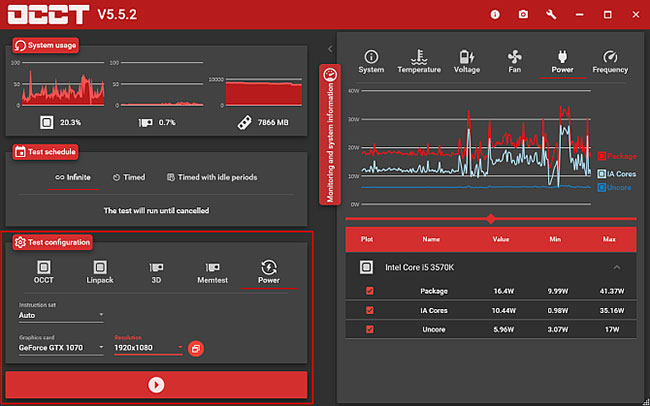
If you want to try testing the PSU software, the article will suggest using OCCT, a free CPU/GPU/PSU stress test tool. OCCT stresses tests the CPU, GPU, and motherboard, detecting any power supply errors in the process.
Check for a faulty PSU with OCCT
Open OCCT. In Test Configuration, select Power. Select the graphics card, then set the resolution to 1920 x 1080. Save all your work and close any other open programs on the system. When ready, press the big red Play button icon in OCCT to start the stress test.
The developer of OCCT claims that most bugs are detected within the first five minutes. However, you should do at least one 1-hour test to ensure effectiveness.
OCCT generates a log highlighting any potential PSU (or other hardware) failures when testing is complete.
One of the "worst" problems that users often encounter on Windows 10 is the black screen error.
The black screen error can occur in some situations on Windows 10, stemming from problems related to the graphics card, the connection error between the computer and your monitor, the error occurring during the installation of the operating system, updating to new versions, etc., or simply happening randomly at any time.
In the article below, the administrator will guide you with some solutions to fix the black Windows 10 screen error.
In addition, if you encounter a black screen error on Windows 7, 8, or 8.1 computers, readers can refer to the steps to fix the error here.
Steps to fix a basic black Windows 10 computer screen
1. Black screen error during installation
Once there, try turning off the computer by pressing and holding the power button for a few seconds. If using a laptop, you can unplug the charger and remove the battery.
Unplug all unnecessa...
Microsoft is currently A/B testing a native dark style for the ChatGPT-powered Bing.com, and it has finally begun distributing out Bing.com to Google Chrome and Safari. On Windows 10 and 11, we got a pop-up that allowed Bing AI access through Google Chrome. It appears that certain people can also access Bing AI through Safari.
One of the most cutting-edge and effective language models for users is Bing AI, which is powered on ChatGPT-4. Since late February, Bing.com AI support has been accessible to Microsoft Edge users. Now, Microsoft is beginning to expand its support to all browsers, including Google Chrome and Apple Safari.
Bing AI pop-up in Chrome | Image Courtesy: Thewindowsfan.com
Anyone may now test Bing AI in Chrome thanks to a new pop-up that has begun to show in the taskbar of Windows 10 or 11. In our experiments, Google Chrome's native dark mode support allowed us to access Bing AI. The screenshot below illustrates how the white background changes to a black...
I could write a whole novel about the peculiar dilemma of maintaining visual coherence in Windows 11. A presentation and summary could be made with the help of Microsoft's Copilot, but guess what? The issue would linger, waiting for the next act.
Despite being the best operating system for productivity and gaming, Windows 11 is still not a unified system. Windows 11 may have a newer look and feel, but it still has some vestiges of older versions.
When users attempt to switch from a Microsoft account to a local one, Windows 11 still refers to the Windows 8 "Search Charm," a bizarre case of inconsistent design. When users try to switch to a local account while device encryption is enabled, they are met with the screen shown below.
" data-sizes="(max-width: 1621px) 100vw, 1621px" /> Charm Bar is mentioned in Windows 11
Windows 8's specialized 'Search Charm' has been removed from later builds of the operating system. Users are st...




Nhận xét
Đăng nhận xét