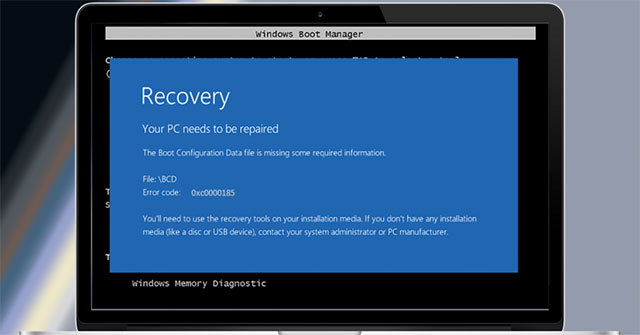
The error code 0xc0000185 almost always appears when a Windows PC boots, usually after a system reboot. It almost always presents as a BSOD error or blue screen of death, with the words "The Boot Configuration Data for your PC is missing or contains certain errors" followed by an error code.
The message may also say, "Your PC needs to be repaired. The Boot Configuration Data file is missing some required information". This error is easily fixed in most cases. Although it is most commonly found on Windows 10, this error also appears on Windows 8.1 and Windows 7.
Cause of error code 0xc0000185
The error code 0xc0000185 is caused by corrupted files related to the boot function of your Windows PC
The error code 0xc0000185 is caused by corrupted files related to the boot function of Windows PCs. Certain files that have been deleted or corrupted in some way, or something as innocuous as a faulty shutdown or a new peripheral, can be the cause of this error.
This can also be the result of malware or faulty hardware, and this error is just a symptom of a developing problem.
How to fix error code 0xc0000185
Whether this error is the main problem affecting your system or there is another serious problem that this error only suggests, you cannot fix anything until the PC is back up and running.
Note:
After you've tried each of these fixes, reboot the system and see if it boots properly. If not, move on to the next solution.
How to fix error code 0xc0000185
1. Restart the computer
A standard reboot isn't very likely to fix this particular problem, but it's still worth a shot, as it's harmless. Windows will fix this in the boot sequence.
2. Rebuild BCD
If this error persists, rebuilding the Boot Configuration Data file is a great next step to take. Access the Advanced Startup Options menu to get started.
3. Rebuild BCD with bootable media
Sometimes Windows startup problems are difficult to fix because you can't access the repair tools you need to use. While you can use another Windows installation drive, a simpler method is to create and use a Windows 10 bootable USB. To create an ISO, download the Windows ISO (for free) from one of Microsoft's sources, then create a bootable USB.
When done, rebuild the BCD in Windows like you probably did in the previous troubleshooting step, but this time, boot to the USB and not the main drive.
4. Perform a system restore
If repairing the BCD does not fix the problem, a more drastic approach is to restore the system to an earlier point in time. Using System Restore can erase apps and data, so if possible, back up anything important to a secondary drive before proceeding. However, as you cannot boot into Windows properly, you will need to run the recovery option from the Advanced Startup Options menu.
5. Format the partition and reinstall Windows
If you're still having trouble starting your PC after completing the steps above, format the drive and reinstall Windows. Back up any important information on the drive, as this will wipe the drive.
Reference:
Learn about error code 0x8007045d and how to fix it
One of the "worst" problems that users often encounter on Windows 10 is the black screen error.
The black screen error can occur in some situations on Windows 10, stemming from problems related to the graphics card, the connection error between the computer and your monitor, the error occurring during the installation of the operating system, updating to new versions, etc., or simply happening randomly at any time.
In the article below, the administrator will guide you with some solutions to fix the black Windows 10 screen error.
In addition, if you encounter a black screen error on Windows 7, 8, or 8.1 computers, readers can refer to the steps to fix the error here.
Steps to fix a basic black Windows 10 computer screen
1. Black screen error during installation
Once there, try turning off the computer by pressing and holding the power button for a few seconds. If using a laptop, you can unplug the charger and remove the battery.
Unplug all unnecessa...
Microsoft is currently A/B testing a native dark style for the ChatGPT-powered Bing.com, and it has finally begun distributing out Bing.com to Google Chrome and Safari. On Windows 10 and 11, we got a pop-up that allowed Bing AI access through Google Chrome. It appears that certain people can also access Bing AI through Safari.
One of the most cutting-edge and effective language models for users is Bing AI, which is powered on ChatGPT-4. Since late February, Bing.com AI support has been accessible to Microsoft Edge users. Now, Microsoft is beginning to expand its support to all browsers, including Google Chrome and Apple Safari.
Bing AI pop-up in Chrome | Image Courtesy: Thewindowsfan.com
Anyone may now test Bing AI in Chrome thanks to a new pop-up that has begun to show in the taskbar of Windows 10 or 11. In our experiments, Google Chrome's native dark mode support allowed us to access Bing AI. The screenshot below illustrates how the white background changes to a black...
Many tasks are constantly operating in the background of Windows 11, just as they were in Windows 10. File Explorer, the notification center, Settings, applications, and even the desktop are all powered by these processes. This results in a large number of processes being launched instantly upon system boot.
Third-party processes can cause issues on your desktop, but the system processes are always safe. As an example, your computer may experience lag or even freeze due to a malicious process associated with a third-party program. If a program or task is frozen, you can force it to respond by opening Task Manager, finding the program's entry, and ending the process.
In Windows 11 version 25300, Microsoft has made it possible to terminate all running processes and tasks with a single click. Windows 11 includes a new feature that can be accessed by right-clicking any app or process icon and selecting the "End Task" option.
New "End Process" button i...




Nhận xét
Đăng nhận xét