The Internet has become such a core part of the way we work and play that some Internet-connected devices can share their connection with other devices. In addition to a smartphone, a Windows 10 device can also be a mobile hotspot and share its Internet connection with other computers.
Windows' Mobile Hotspot feature is convenient and generally easy to use. However, sometimes your Windows 10 hotspot will stop working or prevent other devices from connecting to it. If you are having problems with your mobile hotspot in Windows 10, here are some fixes you can try.
How to fix Mobile Hotspot problems on Windows 10
Important: Before attempting any of the fixes listed below, determine whether the problem affects only one device or all devices. If the problem only occurs on one device, that device may be the problem and not your hotspot. Also, double check that your Internet connection is working properly.
If you think the problem is with your computer, follow the fixes below.
1. Try creating a new connection
If you're having issues with your mobile hotspot, remove the current connection your device has, and then reconnect to the hotspot. In most cases, a new connection can eliminate the authentication error and solve the problem.
2. Temporarily turn off firewall and antivirus software
Your system's firewall, antivirus, or malware program can sometimes block your mobile hotspot. To determine if this is the cause of the problem, disable these apps and connect to the hotspot. If you can connect to the hotspot, enable these apps and see which is causing the problem. If you still cannot connect, re-enable these programs immediately to keep the system protected.
3. Turn off Bluetooth on Windows
Your computer's Bluetooth connection can sometimes interfere with mobile hotspots. Turning off Bluetooth can sometimes fix the problem. Here's how to do it:
Step 1: Open Settings on a Windows 10 computer by pressing and holding the Windows+X. Then, select Settings on the menu.
Step 2: In Settings, select Devices > Bluetooth & other devices. Then set it to Off.
Connect to the hotspot and see if it works. If not, move on to the next fix.
4. Check WiFi adapter
In some cases, you may have a WiFi adapter that does not support the Windows portable hotspot feature. Here's how to check if your adapter can support this feature:
Step 1: Press Win + S to open Windows Search.Step 2: Next, type CMD. Right-click on the Command Prompt search result and select Run as administrator.
Step 3: A pop-up box will appear. Click Yes.
Step 4:In the Command Prompt, type NETSH WLAN show drivers. Check the Hosted network supported line and see if it is Yes or No.
Check the Hosted network supported lineStep 5: If the result is No, it means that your WiFi adapter does not support the mobile hotspot feature. Unfortunately, the only fix for this is to change the adapter. However, if the result is Yes and the devices still cannot connect to the hotspot, follow the next fix.
5. Update all necessary drivers
Downloading the free driver updater for Windows will quickly update all the necessary drivers on your computer. However, if you do not want to install third-party software on your computer, you can update it by using the Windows Update settings.
If optional updates are not available, the necessary drivers have been updated. Continue with the next option.
6. Troubleshooting with network adapters
Windows 10 has built-in troubleshooting tools that help find and fix problems in your device. You can use this tool to fix any network adapter problems. Follow the steps below:
Step 1: Press Win + S to open Windows Search.Step 2: Type Troubleshoot and select Troubleshoot settings from the result.
Step 3: On Troubleshoot site, Click on Additional troubleshooters.
Step 4: In Find and fix other problems setting, select Network Adapter. Then click Run the troubleshooter to start the detection process.
Select Network AdapterStep 5: On the dialog box, you will be asked which network adapter you want to diagnose. Select All network adapters and click Next.
Step 6: Follow the on-screen instructions to fix the hotspot error on your computer.
If the troubleshooter finds a problem with your network adapter, it will suggest a fix or fix it automatically. If it can't find any problems, go to the next step.
7. Link Internet with hotspot adapter
Another fix for this problem is to link the Internet to the hotspot adapter. To do this, follow the steps below:
Step 1: Open Settings by press Win + X and select Settings on menu.
Step 2: In Settings, go to Network & Internet > Mobile hotspot.
Step 3: Make sure that the mobile hotspot is on. Then, click Change adapter options under Related Settings.
Click Change adapter options under Related SettingsStep 4: Right-click on the adapter connected to the Internet. This could be your WiFi or local area network (LAN). Then, click Properties.
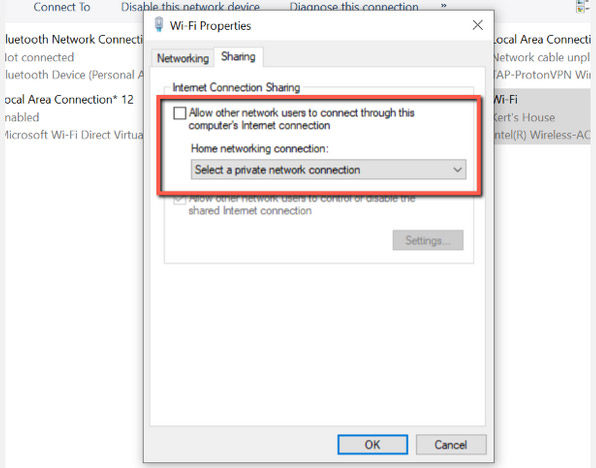
Step 5: Next, click the Sharing tab. Uncheck the option that says Allow other network users to connect through this computer's internet connection, and click OK. (Skip this step if it is already unchecked).
Uncheck the option that says Allow other network users to connect through this computer's internet connectionStep 6: Then right-click on the mobile hotspot's adapter. Click Properties.
Step 7: In the Sharing tab, select the option that says Allow other network users to connect through this computer's Internet connection.
Select the option that says Allow other network users to connect through this computer's Internet connectionStep 8: A pop-up box will appear. Click OK.
Step 9: In the Home networking connection section, select your mobile hotspot adapter.
Step 10: Finally, click OK.
Reconnect to the mobile hotspot and see if it's working. If not, try the next solution.
8. Perform Clean Boot
Startup applications can sometimes cause conflicts with other Windows services. Disabling them may fix hotspot issues. This is how to perform a clean boot.
Clean Boot can reduce software-related conflicts, the root cause of mobile hotspot problems. These conflicts are caused by applications and services running in the background whenever you start your computer. Once they are disabled, the mobile hotspot will work normally again.
One of the "worst" problems that users often encounter on Windows 10 is the black screen error.
The black screen error can occur in some situations on Windows 10, stemming from problems related to the graphics card, the connection error between the computer and your monitor, the error occurring during the installation of the operating system, updating to new versions, etc., or simply happening randomly at any time.
In the article below, the administrator will guide you with some solutions to fix the black Windows 10 screen error.
In addition, if you encounter a black screen error on Windows 7, 8, or 8.1 computers, readers can refer to the steps to fix the error here.
Steps to fix a basic black Windows 10 computer screen
1. Black screen error during installation
Once there, try turning off the computer by pressing and holding the power button for a few seconds. If using a laptop, you can unplug the charger and remove the battery.
Unplug all unnecessa...
Microsoft is currently A/B testing a native dark style for the ChatGPT-powered Bing.com, and it has finally begun distributing out Bing.com to Google Chrome and Safari. On Windows 10 and 11, we got a pop-up that allowed Bing AI access through Google Chrome. It appears that certain people can also access Bing AI through Safari.
One of the most cutting-edge and effective language models for users is Bing AI, which is powered on ChatGPT-4. Since late February, Bing.com AI support has been accessible to Microsoft Edge users. Now, Microsoft is beginning to expand its support to all browsers, including Google Chrome and Apple Safari.
Bing AI pop-up in Chrome | Image Courtesy: Thewindowsfan.com
Anyone may now test Bing AI in Chrome thanks to a new pop-up that has begun to show in the taskbar of Windows 10 or 11. In our experiments, Google Chrome's native dark mode support allowed us to access Bing AI. The screenshot below illustrates how the white background changes to a black...
I could write a whole novel about the peculiar dilemma of maintaining visual coherence in Windows 11. A presentation and summary could be made with the help of Microsoft's Copilot, but guess what? The issue would linger, waiting for the next act.
Despite being the best operating system for productivity and gaming, Windows 11 is still not a unified system. Windows 11 may have a newer look and feel, but it still has some vestiges of older versions.
When users attempt to switch from a Microsoft account to a local one, Windows 11 still refers to the Windows 8 "Search Charm," a bizarre case of inconsistent design. When users try to switch to a local account while device encryption is enabled, they are met with the screen shown below.
" data-sizes="(max-width: 1621px) 100vw, 1621px" /> Charm Bar is mentioned in Windows 11
Windows 8's specialized 'Search Charm' has been removed from later builds of the operating system. Users are st...




Nhận xét
Đăng nhận xét