Desktop personalization is an important aspect of tech life. A personalized operating system helps you stand out, creating a comfortable work and play environment. Therefore, this article covers a bunch of ways you can customize the look and feel of Windows 11.
1. Custom wallpapers
The home screen is the first thing you see after unlocking the system. A great way to personalize your Windows 11 is to set your home screen background to a pretty picture that you like. It could be something as simple as a photo of a loved one or a favorite image. You can go even further by setting GIFs and short videos as your desktop background.
How to use live wallpapers on Windows 11
To do this, select Start, click the Settings icon, and go to the Personalization tab.
Wallpapers settings
On this tab, you will see the Personalize your background tab below. Make sure the Personalize your background tab is set to Picture, and you'll see a selection of pre-installed high-resolution images that you can choose from. If none are to your liking, you can import your downloaded photos by clicking Browse photos.
2. Windows Themes
Windows 11 is an operating system that allows you to personalize more than just the desktop background. The Windows Themes feature lets you sync your customizations, eliminating the need to change individual features. You can save your desktop wallpaper, lock screen wallpaper, apps, window colors, and more in the same theme.
To do this, open Windows Settings, select Personalization, and navigate to the Theme submenu.
Windows 11 themes setting
You can choose from a collection of pre-made themes to change the overall look and feel of Windows 11. You can also create a custom theme by manually changing each feature and saving it by clicking the Save button.
3. Set the slideshow as your desktop background
Just a single photo as the desktop background can be tiring. Thankfully, Windows 11 has a feature that lets you turn your desktop background into a slideshow. This is a great way to add interest to your screen and make it look different from moment to moment.
To do this, open Windows Settings and open the Personalization menu. Navigate to the Background submenu and select the Slideshow option.
Windows 11 slideshow settings
Once you have selected this option, click the Browse button. This will open the File Manager window, from where you can choose a folder containing your favorite images for the slideshow. You can set the duration between image transitions and even shuffle the image order to make things interesting. The slideshow also works well in a custom theme.
4. Custom fonts
Another way to improve the look and feel of the Windows 11 desktop is to change the text font. There are hundreds of unique fonts out there. You can use these two methods to download and install fonts on Windows 11. The font folder is usually compressed.
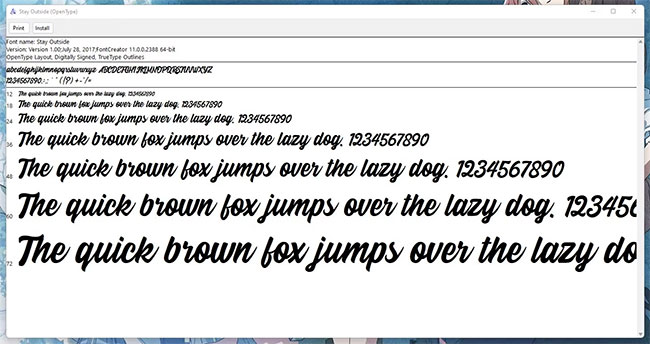
Add font styles to Windows 11
Double-clicking on the font file will open a window showing its preview. Click Install to add the font to the system.
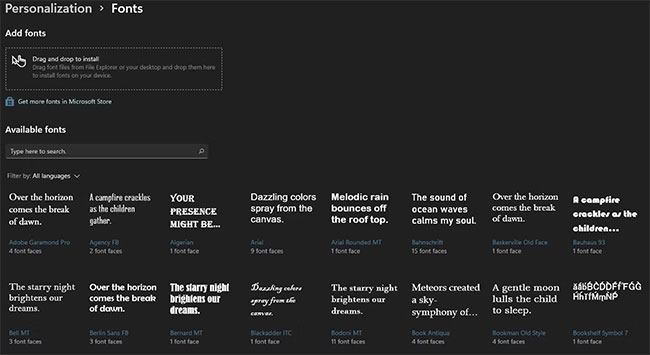
The second method to install fonts on Windows 11 is to drag and drop the font file into the box provided in the Fonts submenu under the Personalization menu. The font will be automatically installed on your computer.
Windows 11 font menu
You can change your system font by choosing from the available fonts in the list provided. You can also change the color of highlighted and unhighlighted text in Windows 11.
5. Custom apps
Another great way to personalize Windows 11 is by using some of the best Windows customization apps. A good example of a custom application is Lively Wallpaper. This free Windows Store app lets you set GIFs, custom images, and even web pages as your desktop background.
Desktop Wallpaper
Lively has several stock wallpapers to choose from, but you can easily add your own to its extensive library.
6. Add apps to the taskbar
The taskbar is a handy feature that gives you quick access to a short list of apps. Unlike previous versions, the taskbar of Windows 11 is centered, but it is still fully customizable. You can add and remove your most-used apps from the taskbar, giving you quick, convenient access to the tools you need when you want.
To pin an app to the taskbar, launch it from the Start menu and right-click the taskbar icon.
Pin to Taskbar
A small drop-down menu will appear with the Pin to taskbar option. After you select this option, that app icon will remain on your taskbar even after you close it.
Also, the process is simple if you want to remove an unwanted app from your taskbar. Right-click on the unwanted application on the taskbar. Select Unpin from Taskbar from the pop-up menu. The app will disappear from your taskbar immediately after you do this.
Unpin from taskbar
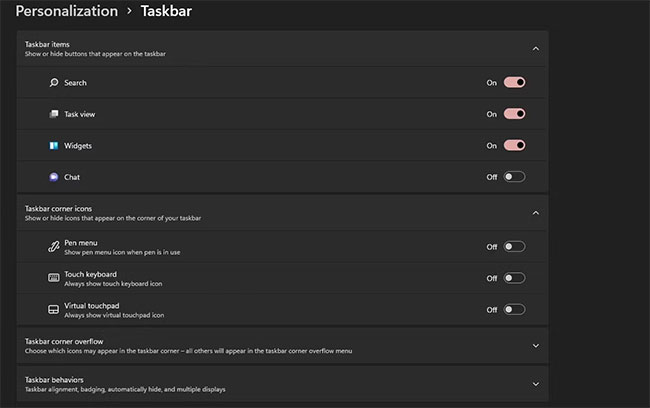
You can also choose which pre-installed system apps to show on the taskbar by accessing the taskbar menu in the settings. To do this, open Windows Settings and navigate to the Personalization tab. Next, click on the Taskbar submenu to open the settings.
Select the application to show on the taskbar
7. Customize the Start menu
The Start menu is a more detailed list of the applications and files available on your computer. You can pin your favorite apps and folders to the Start menu, so that they are always visible whenever you click the Start button.
Click the Start button and scroll to your favorite app. Then, right-click the app and select Pin to Start.
Customize the Start menu
Note that you can only pin a limited number of apps to your Start menu, so choose wisely. You can also customize the Start menu in Windows 11 in other ways, such as using external applications to change the appearance.
8. Customize the system sounds and change mouse pointer
Another way to make your Windows 11 stand out is to change the system sounds and use a custom mouse pointer. The triangle pointer is a classic, but Windows 11 lets you get creative with what you use to select your apps.
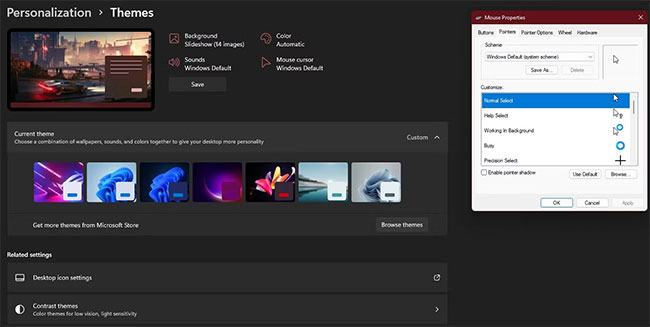
To access this feature, open Settings and the Personalization tab. Next, navigate to Themes and you will see the option to modify the mouse pointer and system sounds.
Customize system sounds and change mouse pointer
When you click on the Mouse Cursor option, a window will appear, allowing you to cycle through a list of predefined pointers that you can choose from. Of course, you could do a little more advanced customization.
You can change your system alerts for different tasks from the Sounds menu. For example, you can customize the charging sound, the device tethering sound, and more. In addition, your custom selections can be saved as themes, allowing you to freely switch between different sounds and pointers at the touch of a button.
Any tweaking comes down to personal preference. Windows 11 allows users to personalize different aspects of the operating system so that they can feel more comfortable using their computer. There are other ways to customize your screen, such as changing your lock screen settings and screen timeout.
As such, Windows 11 allows users to stand out and create their own unique experience.
One of the "worst" problems that users often encounter on Windows 10 is the black screen error.
The black screen error can occur in some situations on Windows 10, stemming from problems related to the graphics card, the connection error between the computer and your monitor, the error occurring during the installation of the operating system, updating to new versions, etc., or simply happening randomly at any time.
In the article below, the administrator will guide you with some solutions to fix the black Windows 10 screen error.
In addition, if you encounter a black screen error on Windows 7, 8, or 8.1 computers, readers can refer to the steps to fix the error here.
Steps to fix a basic black Windows 10 computer screen
1. Black screen error during installation
Once there, try turning off the computer by pressing and holding the power button for a few seconds. If using a laptop, you can unplug the charger and remove the battery.
Unplug all unnecessa...
Microsoft is currently A/B testing a native dark style for the ChatGPT-powered Bing.com, and it has finally begun distributing out Bing.com to Google Chrome and Safari. On Windows 10 and 11, we got a pop-up that allowed Bing AI access through Google Chrome. It appears that certain people can also access Bing AI through Safari.
One of the most cutting-edge and effective language models for users is Bing AI, which is powered on ChatGPT-4. Since late February, Bing.com AI support has been accessible to Microsoft Edge users. Now, Microsoft is beginning to expand its support to all browsers, including Google Chrome and Apple Safari.
Bing AI pop-up in Chrome | Image Courtesy: Thewindowsfan.com
Anyone may now test Bing AI in Chrome thanks to a new pop-up that has begun to show in the taskbar of Windows 10 or 11. In our experiments, Google Chrome's native dark mode support allowed us to access Bing AI. The screenshot below illustrates how the white background changes to a black...
I could write a whole novel about the peculiar dilemma of maintaining visual coherence in Windows 11. A presentation and summary could be made with the help of Microsoft's Copilot, but guess what? The issue would linger, waiting for the next act.
Despite being the best operating system for productivity and gaming, Windows 11 is still not a unified system. Windows 11 may have a newer look and feel, but it still has some vestiges of older versions.
When users attempt to switch from a Microsoft account to a local one, Windows 11 still refers to the Windows 8 "Search Charm," a bizarre case of inconsistent design. When users try to switch to a local account while device encryption is enabled, they are met with the screen shown below.
" data-sizes="(max-width: 1621px) 100vw, 1621px" /> Charm Bar is mentioned in Windows 11
Windows 8's specialized 'Search Charm' has been removed from later builds of the operating system. Users are st...


 Windows 11 themes setting





Nhận xét
Đăng nhận xét